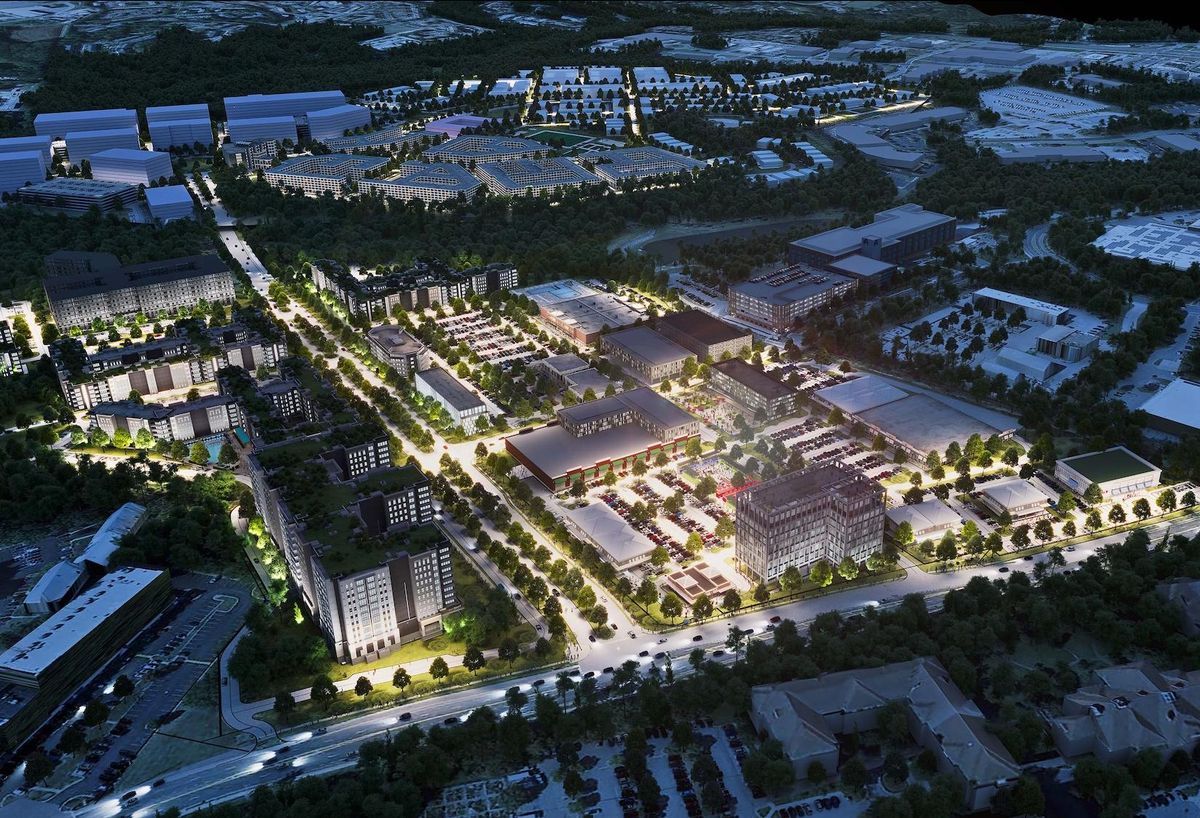
MCB Real Estate secured a 162,000 sq ft Costco lease as the anchor tenant for its planned 280-acre Viva White Oak mixed-use redevelopment adjacent to the FDA, part of a $2.8 billion project that would deliver roughly 5,000 residential units and 3 million sq ft of retail and office space with a life‑sciences focus. Montgomery County recently approved a special development district enabling the county’s first tax increment financing (TIF) deal that could provide MCB up to $420 million in support; the county council must still authorize TIF bonds, with a resolution expected this summer. The Costco commitment signals strong retail demand and de‑risking of leasing for the project, which is material for local commercial real estate investors and municipal credit watchers but likely of moderate relevance to broader markets.
Market structure: Costco’s 162k SF anchor lease is a clear win for COST (membership economics, pricing power) and for life‑science adjacent real estate (Alexandria ARE, multifamily owners AVB/EQR) because an FDA‑proximate cluster raises premium rent prospects. Losers are small-format grocers/strip‑center landlords within a 5–10 mile radius (higher competition; potential foot‑traffic diversion) and any local retail REITs with high exposure to commodity retail. The announced $420M potential TIF increases municipal bond supply risk in the near term and raises construction demand for steel/cement modestly (0.1–0.3% local commodity uplift).
Risk assessment: Key tail risks are (1) TIF bonds not issued this summer (project funding gap), (2) a >100bp rise in Treasury yields before bond pricing causing refinancing stress, and (3) life‑sciences leasing fatigue producing >15–20% vacancy versus modeled. Immediate: limited stock move for COST (days); short term (weeks–months): council vote and bond pricing are binary catalysts; long term (3–7 years): delivery of 5,000 units and 3M SF influences local rents and retail sales per capita. Hidden dependency: MCB’s reliance on TIF ($420M) and any environmental/site remediation liabilities.
Trade implications: Tactical: overweight COST (1–2% of equity book) via Jan 2027 LEAP call spread to capture store build and membership upside, and add 1% position in ARE to play life‑science clustering, size contingent on TIF vote. Pair trade: long COST (0.5–1%) / short KR (0.5%) to express warehouse membership vs traditional grocer compression over 6–12 months. On munis, avoid direct Montgomery County exposure until TIF bond covenants are public; if issuance >$400M, favor short duration municipal underweight vs Treasuries by 6–12 months.
Contrarian angles: The market underestimates cannibalization — three existing Costcos within 10 miles implies incremental store could dilute per‑store sales by mid‑single digits rather than create net new demand. The TIF dependence is a leverage hidden in the headline; if the council delays or tightens covenants, developer equity returns could compress >300–500bps. Historical parallel: long‑range master‑plan projects (e.g., Hudson Yards) showed multi‑year delivery and subsidy politics; don’t pay up for life‑science rent growth until multiple anchor leases and bond issuance clear governance (3–6 months).
AI-powered research, real-time alerts, and portfolio analytics for institutional investors.
Request TrialOverall Sentiment
moderately positive
Sentiment Score
0.45
Ticker Sentiment
