
Speechify's Simba 3.2 Ranks #1 on Independent Artificial Analysis TTS Leaderboard: World's Best Real-Time Voice Model, Above ElevenLabs, OpenAI, Google DeepMind & Others
Source: PRWeb
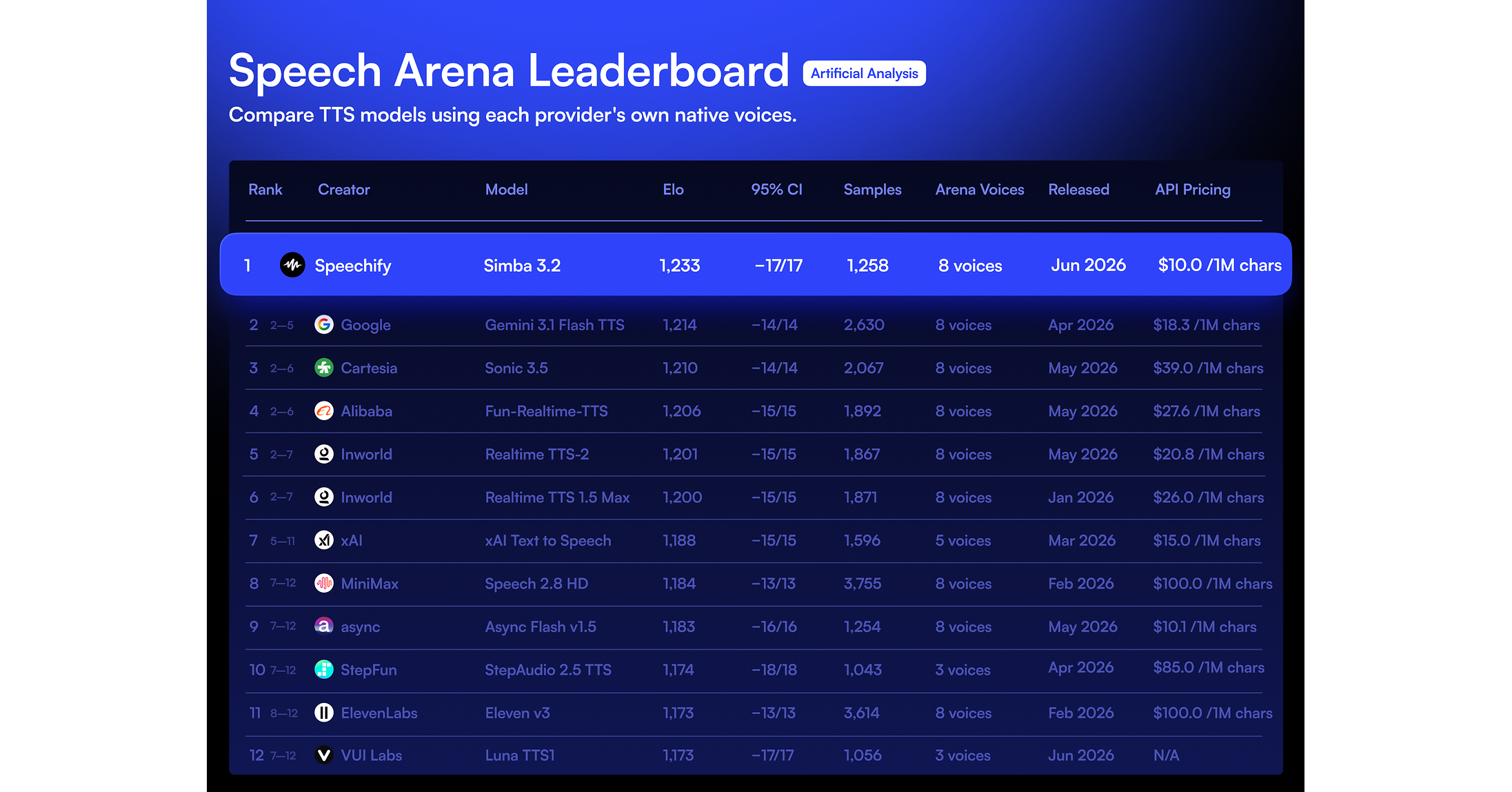
Speechify’s Simba 3.2 streaming TTS model ranks #1 on the Artificial Analysis leaderboard and joint #2 on Voice Arena, with pricing of $10 per 1M characters (dropping to $6 at Scale), making it the least expensive model in the top ten. The benchmarks use blind/independent methodologies and position Simba 3.2 as the top real-time option at its price point. For developers, Speechify also highlights features including lower time-to-first-byte, SSML prosody/emotional control, and instant voice cloning, with availability now via its SpeechifyAI REST API and SDKs.
Analysis
This is less about a single model win and more about where pricing power migrates in voice AI. If best-in-class real-time TTS is already available at near-commodity rates, the economic moat shifts away from raw model quality and toward distribution, latency guarantees, workflow tooling, and embedded endpoints. That is structurally bearish for standalone voice API vendors whose differentiation was partly benchmark leadership, and it favors platforms that can absorb voice as a feature inside a broader product stack.
Near term, the market impact is probably muted for public equities, but the competitive response matters. Over the next 1-3 months, expect more aggressive price compression and marketing spend across the voice stack as peers defend developer mindshare; that can pressure gross-margin assumptions for private benchmarks and reduce the premium investors pay for “SOTA” narratives. Over 6-18 months, the bigger winner is likely downstream application builders in customer support, accessibility, and agentic workflows, where lower inference cost expands usage and raises attach rates.
The contrarian point is that benchmark leadership does not equal durable monetization. Real enterprise adoption depends on SLA stability, telephony performance, multilingual consistency, and compliance under load; if those are weaker than the marketing implies, this could be a temporary leaderboard-driven rerating rather than a true share shift. The thesis is falsified if large customers stick with incumbents despite the price gap, or if rival vendors respond with equally good low-latency models and the pricing edge disappears within a quarter.
For the named publics, the read-through to AAPL is mildly positive because cheaper, better TTS lowers the cost of richer accessibility and voice UI features without needing Apple to own the frontier model. GOOGL is more of a neutral-to-slight negative on the narrative side: if the market views Google DeepMind as behind in voice quality, it reinforces the idea that Google’s AI advantage is distribution-led rather than model-led. But this is not a high-conviction public-market signal yet; the investable edge is in watching whether voice AI adoption accelerates enough to move endpoint owners and cloud providers, not in chasing benchmark headlines.
AllMind Terminal
AI-powered research, real-time alerts, and portfolio analytics for institutional investors.
Request TrialMarket Sentiment
Overall Sentiment
strongly positive
Sentiment Score
0.55
Ticker Sentiment
Key Decisions for Investors
- No immediate outright trade in AAPL or GOOGL on this headline; treat it as a 1-3 month competitive-watch item unless we see evidence of enterprise win/loss data or pricing cuts from major TTS vendors.
- If forced into a relative-value expression, consider a small long AAPL / short GOOGL pair over the next 1-3 months: thesis is that voice commoditization is more helpful for device-level UX monetization than for standalone AI model monetization; stop out if Google shows material cloud/assistant traction or if Apple voice features fail to expand engagement.
- Set an alert on voice-AI pricing benchmarks and customer migration claims over the next quarter; if competitors cut prices by >30% or Speechify shows meaningful production adoption, that is the signal that margin pressure is becoming industry-wide.
- Avoid chasing any “winner” in private voice AI solely on benchmark rank; wait for a second catalyst such as disclosed enterprise deployments, telephony-scale load tests, or usage-based revenue acceleration before taking a more aggressive view.
- For longer-horizon investors, use any pullback in AAPL as an accumulation opportunity only if management continues to show voice/accessibility feature expansion; the optionality matters more over 6-18 months than the headline benchmark itself.
More News
- Apple Smart Home Launch Oct. 13 Plans; HomeView Has Mid-November Release
- Apple's smart home hub will reportedly be called HomeView
- Apple Home's new AI summaries for security cameras cost more than you'd think
- What's the difference between Android Automotive and Google Built-In?
- Apple’s Chinese supplier Luxshare downplays impact of U.S. patent probe
- The new Apple TV could have a built-in mic and a remote with a speaker