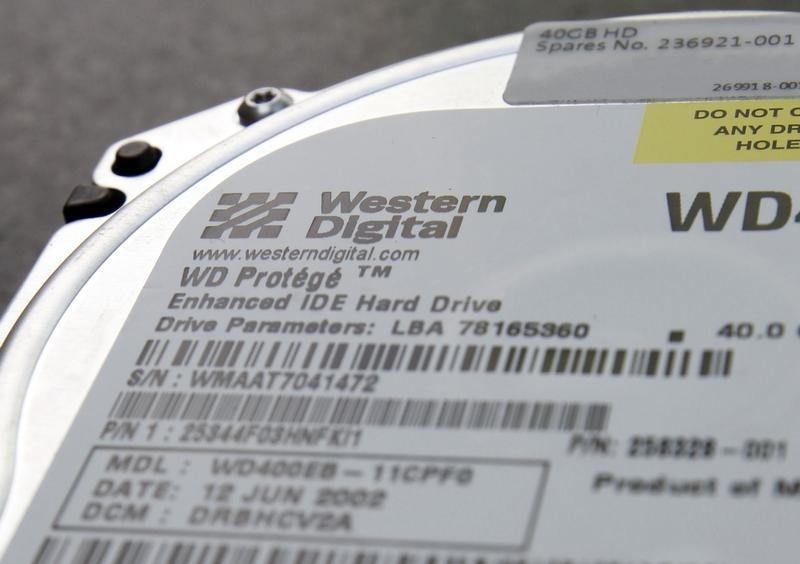
Western Digital rose 5.6% to a new 52-week high after Barclays, Evercore ISI, and Wells Fargo all lifted price targets to $620, $575, and $575, respectively. The stock is being buoyed by strong Q3 fiscal 2026 results, including sequential and year-over-year revenue growth across every end market and gross margin above 50%, plus a 20% dividend increase to $0.15 per share. Analysts cited AI infrastructure demand and persistent HDD supply-demand tightness through 2027 as key tailwinds.
The market is starting to re-rate Western Digital from a cyclical storage supplier into a quasi-infrastructure beneficiary of AI capex, and that has second-order implications across the memory complex. If HDD pricing stays tight into 2027, the real trade is not just WDC upside; it is a delayed pain point for hyperscalers that cannot fully substitute away from capacity storage, which supports continued spend at the low end of the AI stack even if accelerator multiples compress. The underappreciated winner is likely upstream component and equipment ecosystems that gain pricing discipline as HDD supply remains constrained and customers accept longer-duration contracts.
The biggest near-term risk is consensus crowding. Once analysts all converge on the same AI-storage narrative, the stock becomes sensitive to any sign of mix disappointment, contract slippage, or a single quarter of margin normalization after the 50% gross margin milestone. The catalyst window is now to the next 1-2 earnings prints: if WDC can show that pricing power is extending rather than peaking, the stock can keep rerating; if not, the move may have already discounted much of 2026’s good news.
From a relative-value lens, this is more attractive as a pair than an outright long. WDC’s rerating should continue to outpace broad semis if AI storage demand remains under-owned, but Nvidia and Microsoft are more exposed to multiple compression if investors start questioning whether incremental AI capex is shifting from compute to storage and networking. The contrarian view is that the market may be overestimating the duration of HDD scarcity; once customers finish contract resets and 40TB ramps, pricing power can fade faster than bulls expect, especially if any demand softness emerges in enterprise or cloud capex.
Capital return matters here because the dividend increase signals confidence, but it also reduces the need for the market to pay a scarcity premium solely on growth. That makes the stock more resilient in a choppy tape, yet also means upside should increasingly depend on fundamental beats rather than narrative alone. If the supply-demand imbalance truly lasts through 2027, WDC can become a durable cash compounder; if not, the trade becomes a classic cyclical squeeze that should be harvested rather than held indefinitely.
AI-powered research, real-time alerts, and portfolio analytics for institutional investors.
Request DemoOverall Sentiment
strongly positive
Sentiment Score
0.78
Ticker Sentiment
