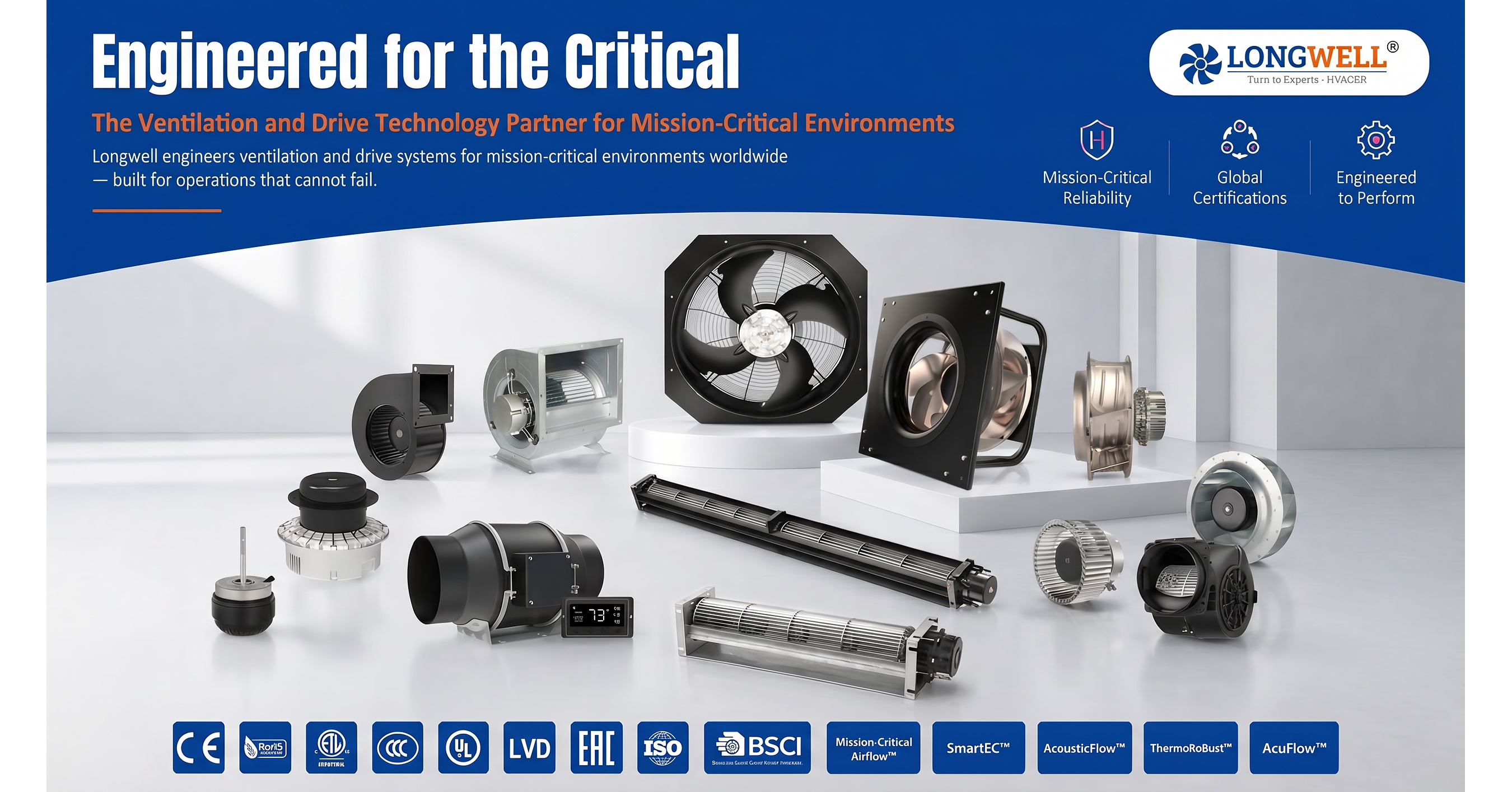
LONGWELL launched a biomimetic EC-fan platform with static efficiency of 73–82% and 4–6 dB(A) lower noise versus conventional fans, enabling 8–12% energy savings. The design improves statics efficiency by 5–8 percentage points, reduces high-frequency noise content by >50%, and increases stall safety margin by 25–30%. In a 2024 European retrofit project, the LWBE3G450 model delivered ~8,660 m³/h and ~30% energy savings above 2,000 Pa, while LWBE3G560 matched an ebm-papst 16,000-class unit for 1:1 replacement. Production lead times are 15–30 days versus 14–22 weeks for imported premium EC-fans, which should support faster customer adoption.
This is more about margin architecture than headline demand. If the performance claims hold in customer qualification, the near-term winners are OEMs and integrators that can swap in a cheaper, faster-supplied component without redesigning the platform; that shows up first in procurement savings and delivery reliability, then in gross-margin protection on retrofit-heavy programs. The clearest losers are incumbent premium fan suppliers with long lead times and a service/brand premium, because the switching cost is now collapsing from engineering complexity to validation discipline.
The second-order effect is on customer behavior: once buyers see a credible 1:1 replacement path, sourcing teams will use it as leverage even if they do not fully switch volumes. That can compress pricing across the broader EC fan and motor ecosystem, especially in Europe where lead-time scarcity has supported premium pricing; the impact is likely more visible in retrofit and data-center cooling than in commoditized HVAC. Public-market exposure is indirect, but names like JCI, TT, AAON and RRX could see different outcomes depending on how much of their bill of materials and aftermarket mix depends on high-end fan modules.
Catalyst path is slow: days for stock reaction, 1-3 months for channel checks and design-win conversations, 6-18 months for actual share shifts. The thesis breaks if field reliability, certification, or acoustic claims fail under mission-critical duty cycles, or if tariffs/geopolitics block adoption. Contrarian view: the market may be overestimating how fast mission-critical buyers will switch; in data centers, a few dB and a few points of efficiency do not matter if supplier qualification, warranty support, or uptime risk is inferior.
AI-powered research, real-time alerts, and portfolio analytics for institutional investors.
Request DemoOverall Sentiment
mildly positive
Sentiment Score
0.25
