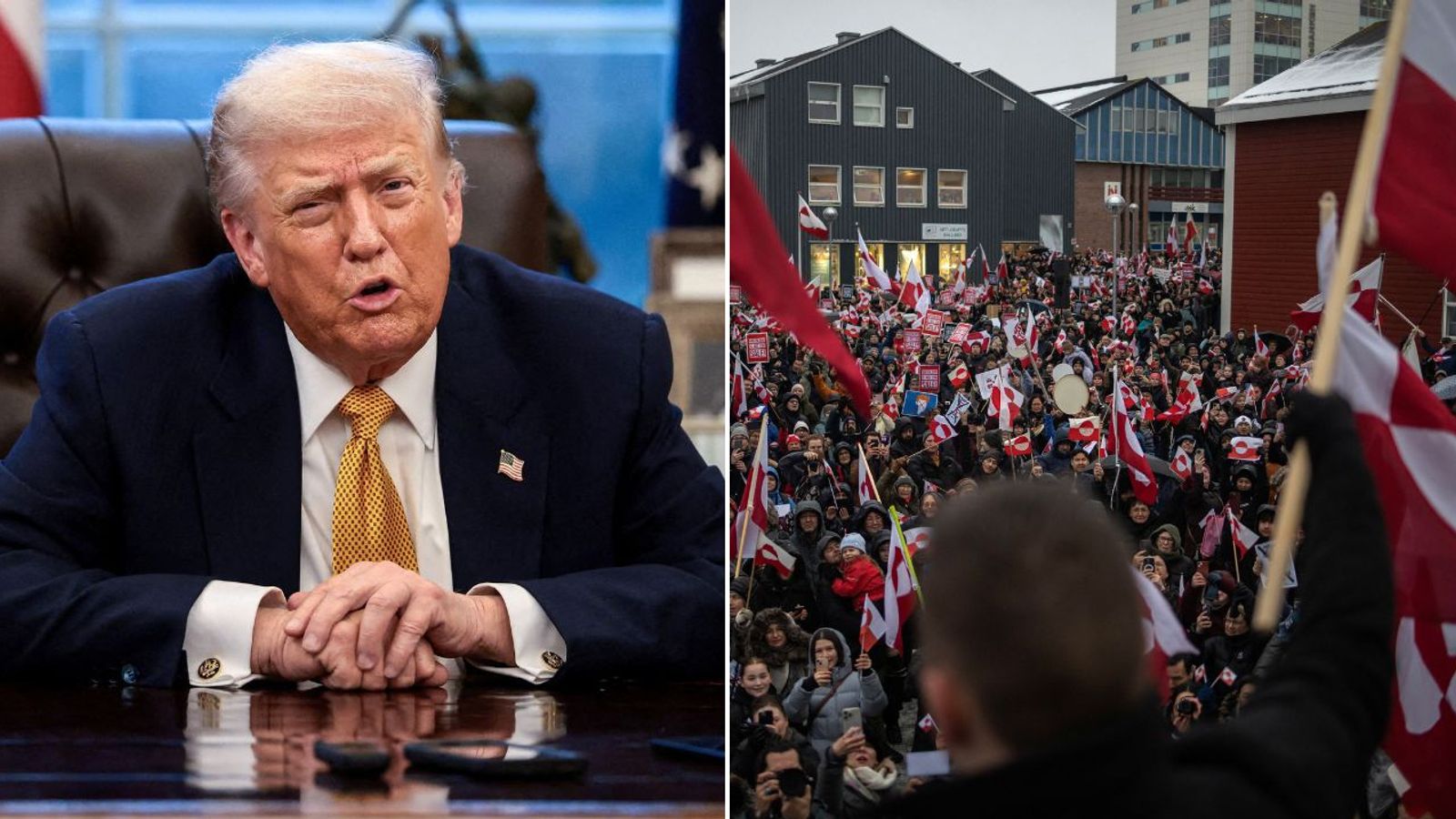
President Donald Trump threatened 10% tariffs effective 1 February—rising to 25% on 1 June—on Denmark, Norway, Sweden, France, Germany, the UK, the Netherlands and Finland unless the US is allowed to purchase Greenland. The announcement, framed as retaliation for allied military deployments to Greenland (France 15 personnel, Germany 13, UK 1), prompted EU emergency meetings, allied condemnation from leaders including Keir Starmer and Emmanuel Macron, and large protests in Copenhagen. The dispute spotlights geopolitical competition over Greenland's critical minerals and raises the prospect of coordinated European trade responses and heightened supply-chain and defense-policy uncertainty.
Market structure: Immediate winners are US dollar and US defense/commodity-plays: tariffs vs. European exporters shift near-term pricing power toward US buyers and suppliers of defense equipment and critical minerals. Losers are European exporters and tourism/consumer sectors in targeted countries—expected 5–10% localized hit to export-sensitive cap-weighted indices if 10% tariffs are enacted on Feb 1, rising non-linearly to 25% on June 1. Commodities tied to Arctic/mineral extraction (nickel, rare earths) gain optionality; shipping/logistics faces rerouting friction. Risk assessment: Tail risks include full EU coordinated retaliatory tariffs, NATO political fracture, or US enforcement actions (blockades/seizures) — low probability but high pain (20–40% sector drawdowns). Time buckets: immediate (days) — FX and vol spikes around Feb 1; short-term (weeks–months) — equity dispersion and credit spread widening in European corporates; long-term (quarters) — re-listing of supply chains and capex into Arctic infrastructure. Hidden dependencies: Danish domestic politics and Greenland autonomy controls are decision nodes; commodity self-sufficiency timelines are multi-year. Trade implications: Construct concentrated long US defense (LMT, RTX, GD) and critical-minerals exposure (MP, RIO) while hedging European export risk via short FEZ or puts on EWG. Use FX trades: 1–2% notional long UUP vs short FXE or EUR/USD spot if tariffs hit Feb 1. Buy GLD as 1% tail hedge. Contrarian angles: Consensus expects short-term geopolitical bluster; the market may underprice the long lead-time capex into Greenland minerals — a 12–24 month staged long in MP and RIO with 20–30% profit targets could outperform. Overreaction risk: if tariffs are announced but quickly legally challenged, European equities could rebound sharply; keep sell-stops and option hedges sized to <50% delta exposure.
AI-powered research, real-time alerts, and portfolio analytics for institutional investors.
Request DemoOverall Sentiment
moderately negative
Sentiment Score
-0.35
