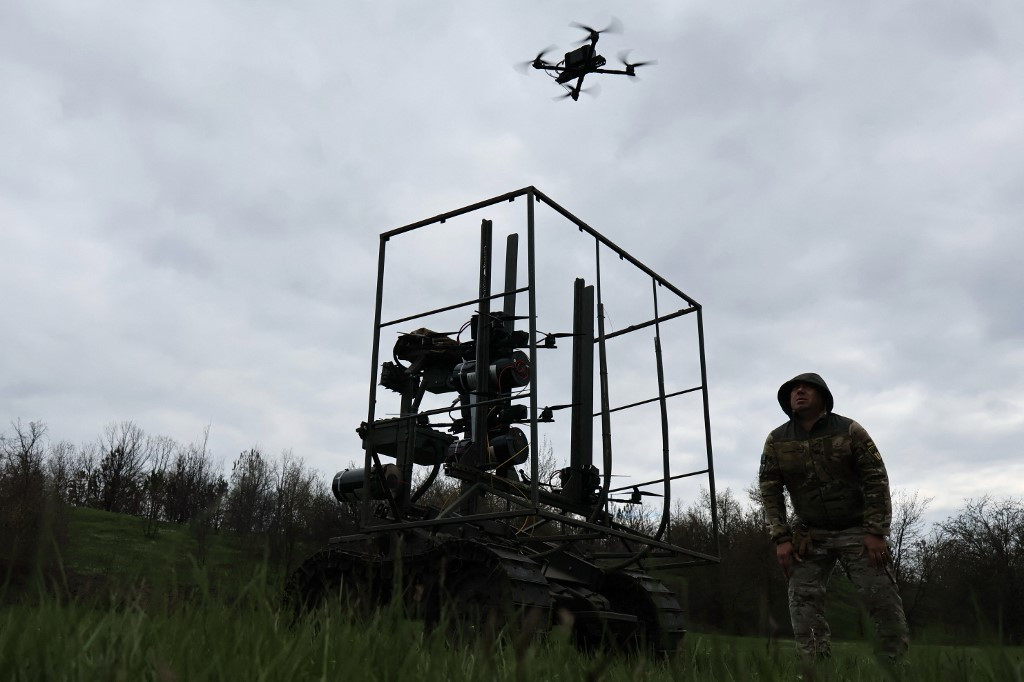
Ukraine’s drone war effort now involves about 80,000 service personnel, with estimated active drone pilots/operators in the 25,000-40,000 range, reflecting a large-scale and rapidly evolving combat capability. The article highlights a nationwide training ecosystem, including private, unit-run, and AFU-operated schools that can turn recruits into competent drone pilots in roughly one to two months. It also points to continued innovation in simulation software and interceptor-drone training, but the piece is primarily descriptive rather than a direct market catalyst.
Ukraine’s drone ecosystem is no longer a boutique battlefield capability; it is becoming an industrialized training-and-iteration loop. The second-order winner is not just frontline units, but the domestic stack around them: low-cost airframes, simulation software, training services, EW-resistant comms, and interceptor payloads all gain from a regime where throughput and software update cadence matter more than platform elegance. That tends to favor smaller, faster-moving defense tech names and suppliers of commodity components over legacy primes built around slow procurement cycles. The key investment implication is that combat drone demand is being pulled forward by training capacity, not held back by it. A scalable training pipeline lowers the bottleneck to fielding operators, which should increase unit consumption of airframes, batteries, optics, radios, and repair parts over the next 2–4 quarters; the result is a durable pull-through effect on the whole ecosystem. The most interesting second-order effect is on simulation: once battlefield tactics are being encoded into software at high frequency, training becomes a software subscription problem, creating recurring revenue and stickier adoption than one-off hardware sales. The contrarian risk is that the market may overestimate how much of this translates into immediate monetizable demand outside Ukraine. Classified locations, rapid platform changes, and wartime procurement risk mean some “winner” companies may remain non-scalable or politically constrained. Also, if external military aid normalizes or the conflict tempo changes, the urgency premium embedded in training and interceptor demand could fade faster than the company-specific narratives suggest. For public markets, the cleanest trade is to prefer names with exposure to cheap autonomous systems, simulation, and counter-UAS rather than large manned-aircraft exposure. The duration of the trade is months to years, but the catalyst window is shorter: every escalation in drone usage or interceptor adoption should re-rate suppliers with visible backlog and software-like recurring revenue. The risk/reward is strongest where valuation still reflects legacy defense multiples, not venture-style strategic scarcity.
AI-powered research, real-time alerts, and portfolio analytics for institutional investors.
Request DemoOverall Sentiment
neutral
Sentiment Score
0.15
