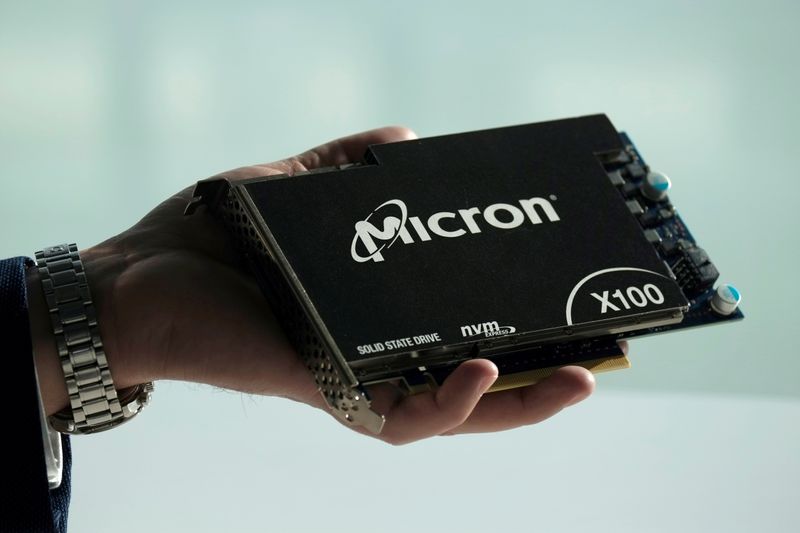
Micron options volume surged to 1.28 million contracts by 2:20 p.m. ET, with calls at 741,810 and puts at a record 535,978, signaling elevated speculative activity. The most active trade was the May 8, 2026 $700 put with 20,219 contracts, while Micron shares jumped 13.1% to $731.24. Three-month volatility rose 5.35 percentage points to 85.52%, reflecting sharply higher implied risk and positioning.
The key signal is not the headline move in the chip complex, but the speed and shape of derivative demand: MU is seeing both calls and puts explode, which usually means a regime shift in implied distribution rather than simple directional conviction. That matters because a volatility repricing at this scale tends to feed back into equity ownership as dealers hedge more aggressively, mechanically amplifying near-term trend persistence in the underlying and in related suppliers like AAPL and INTC.
For AAPL, a preliminary chip-making relationship is strategically more important than it is financially near term: it reduces single-vendor dependency and gives Apple more optionality if leading-edge capacity tightens. For INTC, any external validation of foundry capabilities is a much-needed narrative reset, but it is still a proof-of-execution story, not a fundamentals inflection; the market will likely demand evidence of yield, margin, and customer conversion before rerating the stock beyond a tactical squeeze. MU is the cleaner trade because the options tape suggests investors are paying up for convex exposure to a continuing memory upcycle, and the elevated skew/vol implies the market is debating whether this is an earnings revision story or just a momentum blow-off.
The contrarian risk is that the crowd is extrapolating one positive catalyst into a broad semiconductor re-rating. If the Apple/Intel signal is read as a structural supply-chain shift, that can become a short-term positioning trap: the most crowded winners can stall if forward guidance does not confirm incremental demand, while the highest vol names suffer the most from any disappointment. The trade-off is time horizon: this is a days-to-weeks flow trade in the options market, but a months-long fundamental story only if the deal translates into durable capacity commitments, margin expansion, or share gains.
Second-order, a stronger Intel foundry narrative can pressure other outsource manufacturing and equipment names indirectly by reviving expectations for non-TSMC diversification, but the real beneficiary is likely whoever becomes the gating resource in advanced packaging and high-end substrates. If memory demand remains tight, MU can outperform without needing a perfect demand story; if pricing rolls over, the current volatility premium compresses fast and leaves late call buyers exposed.
AI-powered research, real-time alerts, and portfolio analytics for institutional investors.
Request DemoOverall Sentiment
mildly positive
Sentiment Score
0.25
Ticker Sentiment
