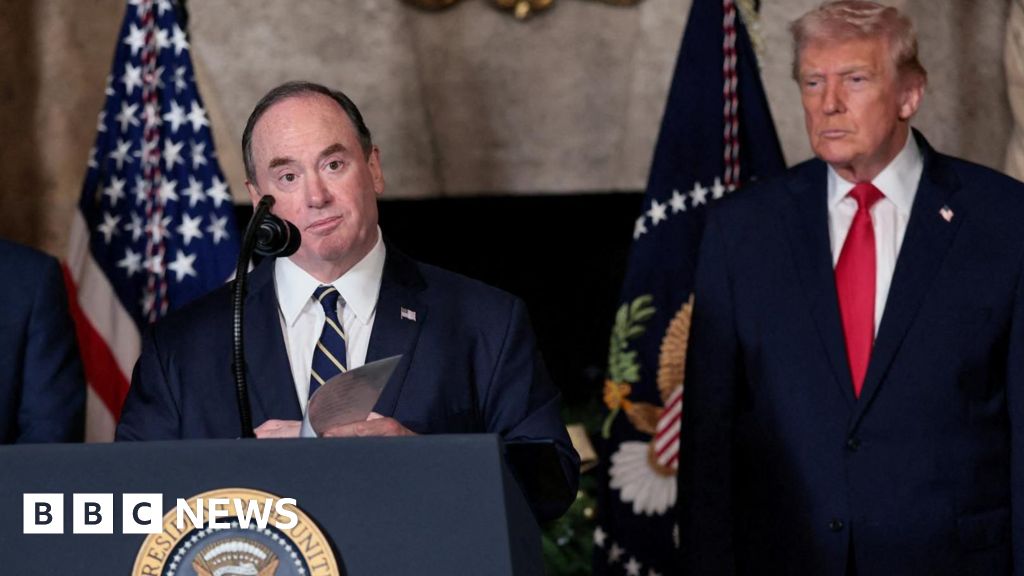
US Navy Secretary John Phelan is leaving the Trump administration effective immediately, with Navy Undersecretary Hung Cao stepping in as acting secretary. The change comes amid the US-Israel war with Iran, an ongoing US blockade of the Strait of Hormuz, and continued disruption risk to a vital global shipping route. The article adds to recent senior Pentagon turnover, but the immediate market focus is on the geopolitical and logistics implications rather than any direct financial metric.
This is less a Navy-specific event than a signal that the administration is prioritizing loyalty and pace over institutional continuity inside the defense apparatus. The second-order market effect is a higher probability of procurement whiplash: programs tied to shipbuilding cadence, logistics modernization, and merchant-marine expansion become more execution-risky because budget authority is not the binding constraint — managerial throughput is. That tends to favor prime contractors with broad backlogs and low near-term Navy dependency, while hurting smaller names and shipyards whose equity cases depend on stable program timing.
The broader geopolitical overlay is more important for commodities and transport than for defense equities in the first instance. A prolonged Strait of Hormuz disruption raises the odds of persistent freight-rate dislocation, insurance repricing, and precautionary inventory builds across refiners, chemical producers, and Asian importers; the market usually underestimates how fast working capital needs rise when routing uncertainty becomes a quarter-long rather than week-long issue. Even if the blockade is partially symbolic, the tail risk is enough to support a volatility bid in crude-linked assets and tanker/war-risk insurance-sensitive names over the next 2-8 weeks.
Contrarian read: the leadership churn may actually accelerate decisions rather than delay them, especially if the replacement is aligned with the White House's preferred industrial policy. That means the right trade is not a blanket short defense, but a dispersion trade between policy winners and execution losers. The market is likely underpricing how much this favors politically aligned platforms, while overestimating near-term benefits for the broader Navy supply chain, which still faces bottlenecks in yards, skilled labor, and legacy procurement processes.
If the Strait tension de-escalates, the fastest reversal is in freight and crude volatility; if it escalates, the catalyst window is days, not months, because inventory and shipping routing reactions are immediate. The medium-term catalyst is a renewed procurement push into merchant and auxiliary fleets, which would be positive for select shipbuilders and marine systems providers but not for the entire defense complex.
AI-powered research, real-time alerts, and portfolio analytics for institutional investors.
Request TrialOverall Sentiment
neutral
Sentiment Score
-0.05
