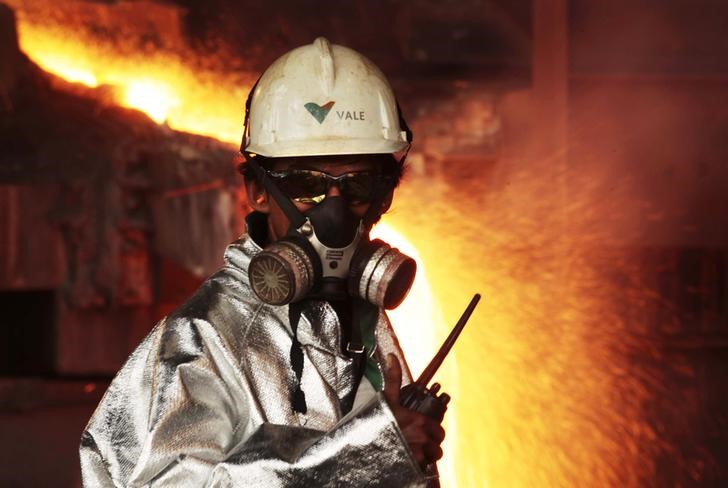
Barclays downgraded Vale to Equalweight from Overweight while raising its price target to $17.00 from $16.50, citing the closure of its valuation gap after a 35% YTD rally. The stock trades at 5.65x EV/EBITDA and a 5.91% dividend yield, but Barclays sees limited further upside as iron ore pricing remains flat and seasonality is expected to weigh on prices. Vale continues to post strong operational results, with Q1 production beating expectations across copper, nickel, and pellets.
Vale’s rerating is now more about multiple compression resistance than commodity beta: once a stock is valued at a near-market EV/EBITDA despite offering high cash conversion and a sizable dividend, incremental upside usually requires a new catalyst, not just “good execution.” The key second-order issue is that the market has effectively pulled forward several quarters of stable iron-ore pricing, so any seasonal softness or inventory normalization can hit the equity harder than the spot commodity because positioning is already crowded toward the quality/miner carry trade.
The more interesting relative-value read-through is to other bulk-miner exposures and downstream steel names. If Vale is priced as if iron ore were materially above spot, then low-cost peers with less balance-sheet flexibility or higher operating leverage become the cleaner way to express a China/iron ore view; meanwhile, steel producers are the beneficiaries if feedstock remains subdued for 1-2 quarters, because margins can expand even without a big move in end-demand. Vale’s India expansion is strategically positive, but it is a medium-horizon demand diversification story, not a near-term earnings re-rating trigger.
The main risk to the bearish-valuation argument is a reflexive squeeze in iron ore if supply disruptions or geopolitics tighten seaborne availability; that would matter quickly, within days to weeks, because the equity is still trading with commodity-like convexity. But absent a sustained break above current spot, the asymmetry has shifted: upside from here looks incremental, while downside on any commodity disappointment can be abrupt because the stock is already near cycle-high pricing. Consensus may be underestimating how quickly the market can rotate from “best-in-class miner” to “fully owned carry,” especially if dividend yield becomes less compelling versus short-duration rates.
For Barclays specifically, the downgrade is less a fundamental call on Vale’s operations and more a warning that the next 10-15% upside likely needs a materially stronger iron ore tape. That creates a useful window to express relative value rather than outright commodity direction, with better risk control than chasing the stock after a 35% YTD move.
AI-powered research, real-time alerts, and portfolio analytics for institutional investors.
Request DemoOverall Sentiment
neutral
Sentiment Score
0.05
Ticker Sentiment
