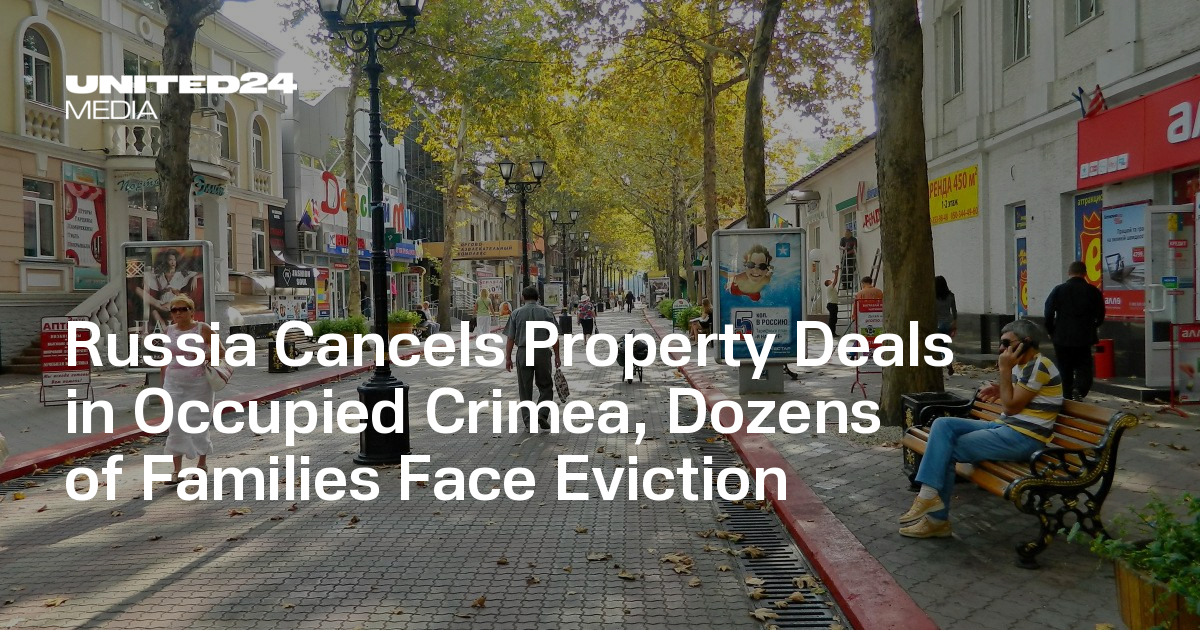
At least 80 families in Uyutne, Crimea face possible home demolition as Russian-controlled authorities reopen and reverse prior property registrations granted under occupation procedures. The article says residents could lose land and housing without compensation, reflecting broader confiscation and legal uncertainty in occupied Crimea. The issue is geopolitically significant but likely limited direct market impact.
This is less a one-off property dispute than a signal that the occupation regime is moving from permissive asset-grab to retroactive legal cleanup. That matters because it raises the probability of broader title invalidation across Crimea: once the state starts reopening settled cases, every “legalized” asset becomes a contingent liability, which should suppress secondary-market liquidity, mortgageability, and new construction activity for quarters, not weeks.
The immediate losers are households, local contractors, and any adjacent businesses dependent on steady housing turnover or municipal permitting. The second-order effect is a self-reinforcing freeze in capex: when ownership can be challenged after the fact, developers demand a higher risk premium, banks pull back on collateral value, and suppliers get paid slower, which can ripple into cement, materials, and utility buildout across occupied areas.
Operationally, the bigger market signal is not the evictions themselves but the administrative strain: retroactive confiscation creates legal overhead, court backlog, and local corruption incentives, all of which reduce the regime’s ability to convert occupied territory into productive tax base. Over 6-18 months, that tends to increase dependence on central transfers and coercive enforcement rather than normal economic activity, which is structurally negative for regional resilience and any reconstruction thesis tied to “stabilization.”
The contrarian read is that the headline risk is probably underestimated for local real-estate values but overestimated for broader Russia macro. This is not a catalyst for sanctions by itself; the investable implication is mainly for asset quality and governance discounting in any proxy assets exposed to Crimea-adjacent normalization narratives. The cleanest trade is to fade any optimism around occupied-territory redevelopment as a monetizable theme until title certainty improves, which is unlikely on a 12-month horizon.
AI-powered research, real-time alerts, and portfolio analytics for institutional investors.
Request TrialOverall Sentiment
strongly negative
Sentiment Score
-0.75
