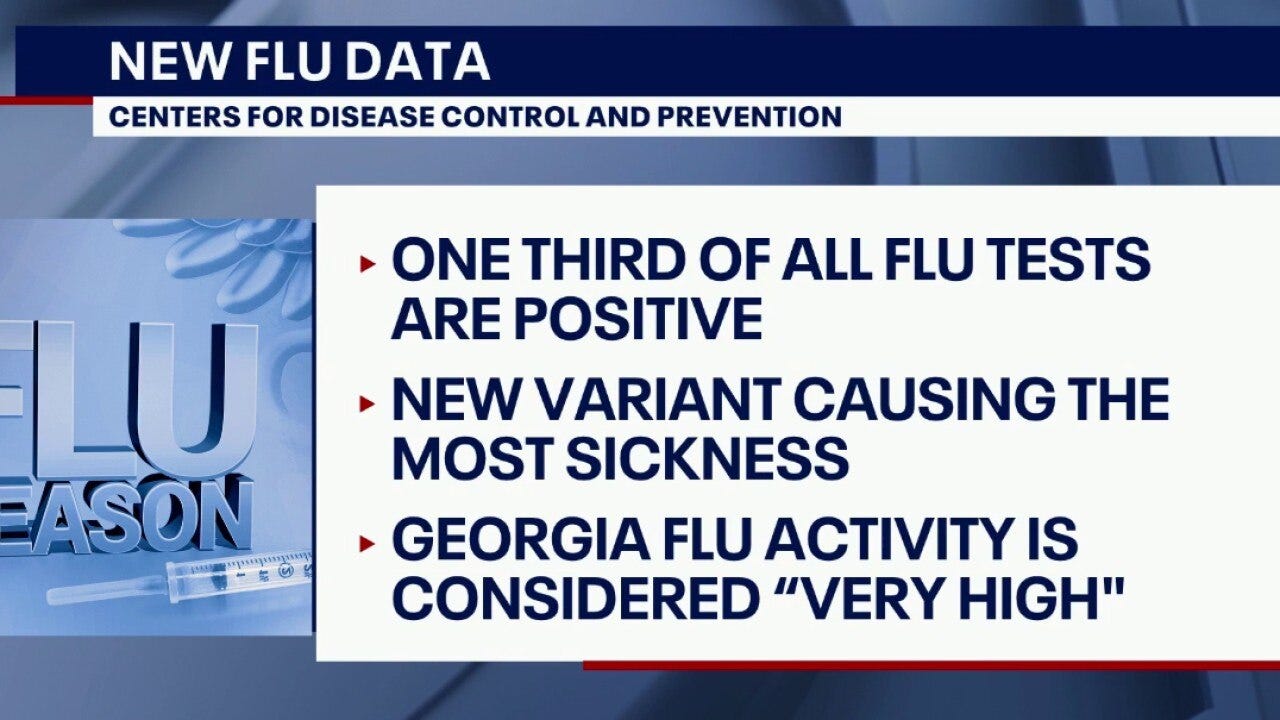
Georgia has surged into the highest 'very high' flu activity category with the week ending Dec. 27 recording seven flu-associated deaths, 511 hospitalizations and 12 confirmed outbreaks; since early October the state has reported 29 deaths, 1,580 hospitalizations and 73 outbreaks. Nearly one-third of clinical lab tests are positive and CDC identifies influenza A(H3N2) as the dominant, typically more severe strain, prompting public-health calls for vaccination and early treatment—an outcome that may increase regional healthcare utilization and short-term absenteeism but is unlikely to be broadly market-moving.
Market structure: A pronounced H3N2 wave (Georgia positivity ~33%) favors diagnostics (LabCorp LH, Quest DGX), retail vaccinators (CVS, WBA) and hospital revenue generators (HCA, THC) via higher admissions and testing volumes. Expect volume-driven revenue gains of ~15–30% for diagnostics and retail vaccination services over the next 4–8 weeks; vaccine makers (GSK, SNY, PFE, MRNA) see milder margin impact because pricing is contract/seasonality-driven and production limits cap upside.
Risk assessment: Tail risks include a vaccine-strain mismatch or a more virulent mutation prompting state emergency declarations and emergency procurement (3–6 weeks lead), plus staffing-driven margin compression in hospitals if ICU demand spikes >20%. Immediate (days) effects: testing and OTC antiviral demand; short-term (weeks–months): hospital occupancy and retail vaccine revenue; long-term (quarters): policy/regulatory scrutiny on pricing and expanded public stockpiles could cap manufacturer upside.
Trade implications: Tactical longs: establish 2–3% positions in LH and DGX to capture a 4–8 week uplift; add 1–2% long in CVS/WBA to capture walk-in vaccines through Feb (buy 60–90 day call spreads if preferred). Hedge: short 1% positions in travel names (AAL or IATA ETF) for a 4–6 week window; options: buy 45–75 day call spreads on DGX/LH or buy puts on regional airline ETF (IYT) as asymmetric protection.
Contrarian angles: The market underestimates recurring seasonality — diagnostics and pharmacy revenues are stickier than headlines imply, while the panic bid in small-cap mask/OTC plays is likely overbought and mean-reverting within 2–6 weeks. Historical H3N2 seasons (2017–18) produced ~10–20% quarterly volume bumps for labs; watch for a policy catalyst (CDC guidance change or state emergency) that can abruptly re-rate manufacturers or cap prices.
AI-powered research, real-time alerts, and portfolio analytics for institutional investors.
Request DemoOverall Sentiment
moderately negative
Sentiment Score
-0.35
