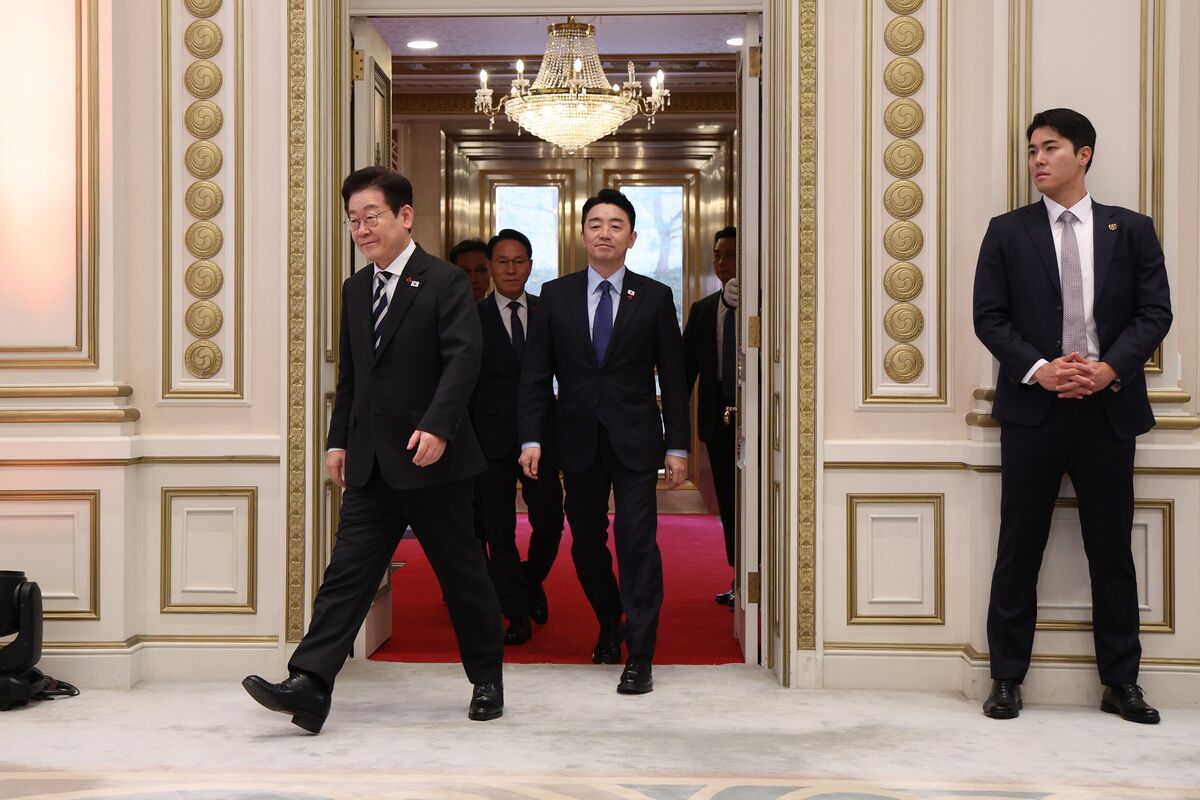
President Lee Jae Myung has restored political stability in South Korea since taking office in June and is leveraging his popularity to advance investor-friendly measures aimed at spurring domestic markets. He has extracted concessions from U.S. President Donald Trump, defused outrage over the arrest of hundreds of Korean workers in Georgia, and mounted a robust response to U.S. tariffs and investment demands — developments that should improve foreign investor sentiment and could support Korean asset prices, although the article provides no specific fiscal or market-impact figures.
Market structure: Political stability under President Lee is a demand-side catalyst for Korean equities (KOSPI/EWY), large-cap exporters (Samsung 005930.KS, SK Hynix 000660.KS) and financials as foreign inflows resume; expect KRW appreciation of 2-5% and 10‑yr Korea Treasury Bond (KTB) yields to rise 10–30bp on rotation out of safe-havens, while implied equity volatility (V/KOSPI) falls 10–20% in the first 1–3 months. Competitive dynamics favor firms with on‑shore capex and FDI sensitivity (semiconductor fabs, battery manufacturers), pressuring marginal global suppliers without South Korea ties. Supply/demand: increased FDI and trade-facilitation reduce funding stress for corporates, tightening credit spreads by an estimated 20–50bp over 6–12 months if policy continues.
Risk assessment: Tail risks include a political reversal or North Korea/US tariff shock causing >10% KOSPI drawdown within days; reinstated US tariffs or renewed worker-exposure disputes could flip flows within weeks. Hidden dependencies: the rally depends on US-Korea trade/FTA signals and semiconductor cycle recovery — a global memory-device demand shock would negate gains. Key catalysts to watch in next 30–90 days: Lee’s fiscal/tax announcements, US tariff talks, Q4 earnings from Samsung/ SK Hynix.
Trade implications: Tactical: establish 2–3% long in EWY over 2–6 weeks, overweight Samsung and SK Hynix (1–2% each) for 3–12 months; complement with 3‑month EWY calls 10% OTM (size 0.5–1% notional) to leverage upside while buying 30% hedge via put spreads on semis. Fixed income/FX: trim EM duration by 0.25–0.5yr now; take a 0.5–1% portfolio KRW long via forwards and unwind if USDKRW moves +3% against entry or 10-yr KTB >30bp wider. Sector rotation: favor semiconductors, capital goods, banks; reduce long-duration sovereigns and defensive utilities.
Contrarian angles: Consensus may underprice policy fragility and semiconductor cyclicality — a 15–25% correction in semis would reverse gains even if politics stabilizes. Overdone reactions risk: KRW strength above 5% would compress exporters’ USD revenue margins, offsetting equity rerate; historical parallel: 2016–18 Korea political shocks produced sharp rebounds but with 20–30% volatility, so size positions with tight triggers. Unintended consequence: rapid capital inflows could force BOK tightening within 6–9 months, increasing local rates and capping equity multiples.
AI-powered research, real-time alerts, and portfolio analytics for institutional investors.
Request DemoOverall Sentiment
mildly positive
Sentiment Score
0.32
