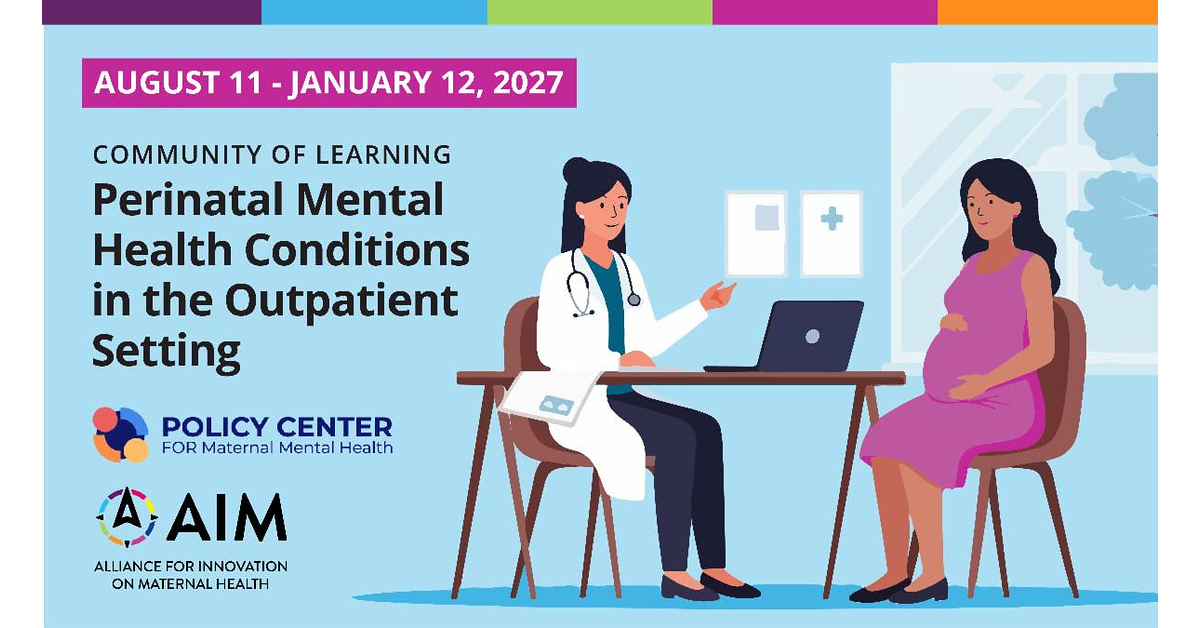
The Policy Center for Maternal Mental Health launched a six-part Community of Learning to help states implement perinatal mental health integration in routine maternity care, using the AIM Perinatal Mental Health Conditions (PMHC) Patient Safety Bundle in outpatient obstetric offices. The program targets an issue where roughly one in five pregnant/postpartum individuals are affected, and about 50% of cases go undiagnosed or untreated. The announcement is focused on care delivery workflows and financing strategies rather than any specific company or financial market trigger.
This is more of a reimbursement-and-workflow story than a near-term earnings catalyst. The real economic lever is not screening awareness; it is whether states and payers convert screening/referral into a billable, audited workflow that OB practices can actually execute without adding uncompensated labor. Absent that, uptake will be patchy and the revenue effect for public names is likely de minimis in the next 1-2 quarters.
Winners, if the program gains traction, are companies that monetize care navigation and low-acuity behavioral health at scale: managed care organizations, Medicaid administrators, tele-mental-health platforms, and EHR/workflow vendors. The second-order loser is the fragmented independent OB practice model, where compliance burden rises faster than reimbursement, pushing more referrals into larger health systems or vertically integrated networks. Over 6-18 months, this can modestly favor integrated payers/providers with strong quality programs because they can capture downstream savings from fewer ED visits, fewer postpartum complications, and better retention in plan-covered care.
The contrarian point: the market may overread the policy signaling. Maternal mental health is a high-need area, but the binding constraint is clinician capacity and state budget discipline, not demand generation. If states do not attach payment codes, quality bonuses, or Medicaid contracts to the bundle, implementation will be largely symbolic. Falsifiers: no reimbursement update in 1-2 Medicaid cycles, low adoption in state perinatal collaboratives, or evidence that screening volume rises without referral completion.
Near term, this is a watchlist item, not a catalyst trade. The set-up becomes investable only if a large state or managed-care contract explicitly pays for integrated perinatal behavioral health, at which point care-management beneficiaries should rerate modestly.
AI-powered research, real-time alerts, and portfolio analytics for institutional investors.
Request DemoOverall Sentiment
neutral
Sentiment Score
0.05
