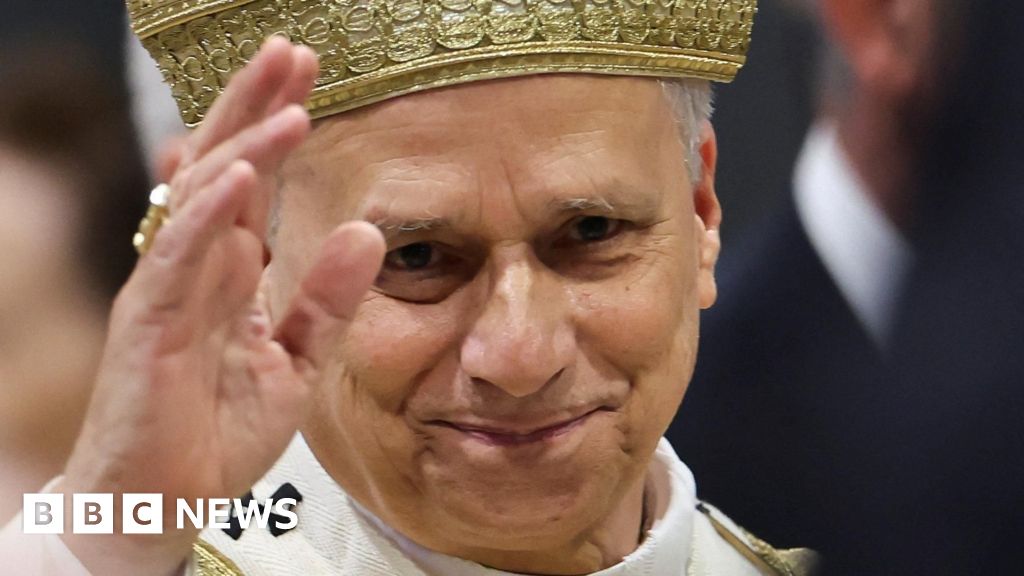
The article centers on escalating rhetoric between Pope Leo and President Trump over the US-Israel war on Iran, with Trump accusing the Pope of undermining US policy and the Vatican insisting there is no deep rift. US Secretary of State Marco Rubio is visiting the Vatican for two days to discuss bilateral relations and the Middle East, while Italian Prime Minister Giorgia Meloni has also weighed in. The story is politically charged but has limited direct market implications.
The market implication is not the headline spat itself; it is the probability that U.S.-Vatican relations become a visible proxy for a broader clash between the administration and Catholic constituencies in swing-state politics. That matters because the Vatican is an unusually efficient amplifier: its signals can shape clergy-level messaging, immigrant/community sentiment, and perceptions of moral legitimacy far beyond the diplomatic channel. The immediate macro effect is probably limited, but the reputational spillover can alter policy tone on Ukraine/Middle East and create noise around any Catholic-adjacent domestic agenda items over the next 1-3 months.
The second-order risk is for Italian political positioning. Any public frictions between Washington and the Holy See give Giorgia Meloni a narrow opening to look statesmanlike relative to Trump without fully breaking with him, which can help her domestically and complicate U.S.-Italy coordination on defense and energy. In parallel, the episode increases the odds that transatlantic conservative coalitions become less cohesive around moral-issue voters, which is a subtle headwind for Republican turnout enthusiasm if the rhetoric escalates into a sustained clash rather than a one-off exchange.
The contrarian view is that this is more useful for Trump than for the Vatican from a media cycle perspective: confrontation with a global religious figure can re-center his base on identity conflict and crowd out less favorable policy coverage. That means the trade is not simply “risk-off” on the White House; the overreaction risk is on assuming durable institutional damage. Unless the Vatican actively coordinates with European leaders or issues sharper language on conflict policy, the episode likely fades in days, not quarters.
The cleanest market expression is in event-driven and sentiment-sensitive names rather than broad index hedges. If this escalates, the most vulnerable assets are firms with high Catholic consumer exposure and heavy reliance on emotional brand affinity in the U.S.; if it fades, the move should reverse quickly. The better asymmetry is to wait for a second leg of headlines before paying up for protection, because the first impulse is often headline-only and mean-reverts fast.
AI-powered research, real-time alerts, and portfolio analytics for institutional investors.
Request DemoOverall Sentiment
neutral
Sentiment Score
-0.05
