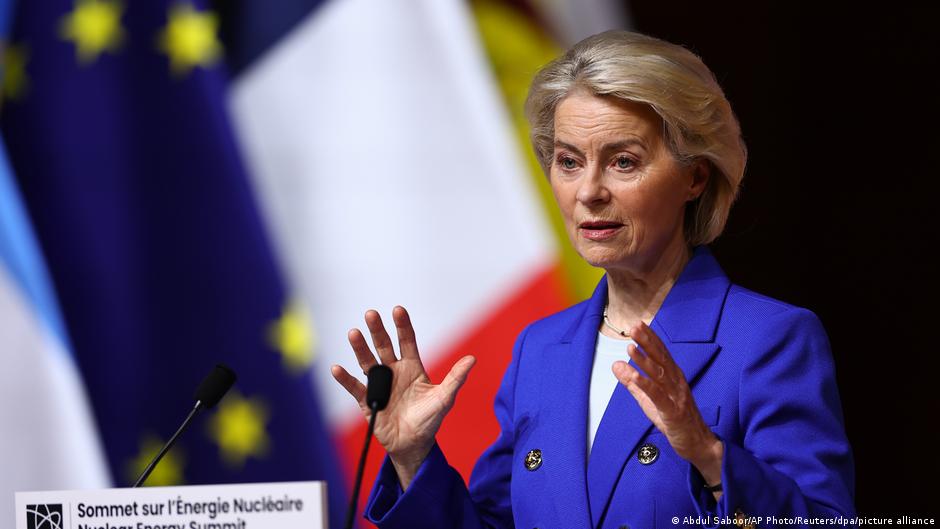
EU Commission President von der Leyen announced a €200M ($230M) fund for nuclear innovation and set a goal to roll out small modular reactors (SMRs, ~300 MW each) across the EU by 2030 with harmonized regulations. She noted nuclear's share of EU electricity fell from ~33% in 1990 to ~15% today, while France still sources >66% of its power from nuclear. Geopolitical pressures from the US‑Israeli war with Iran, damage to refineries and Strait of Hormuz closures are cited as drivers for energy sovereignty; Euratom data show 2024 uranium supplies were 34% Canada, 24% Kazakhstan and ~15% Russia, and French customs reported 39% of enriched uranium imports from Russia in 2025.
The political pivot toward rebuilding a European nuclear industrial base will primarily re-price supply-chain scarcity rather than instantly alter power generation economics. Expect near-term spikes in demand for uranium, enrichment slots and specialized reactor components as governments accelerate procurement cycles; these are capital-intensive bottlenecks with multi-year lead times, so price moves will front-run actual MW additions.
Incumbent vertically integrated players (reactor OEMs, national champions and engineering houses) gain leverage from any move to standardize designs because procurement tends to cluster and favors firms with existing license/maintenance footprints; conversely, one-off foreign bidders and nascent OEMs face a higher cost of entry. Secondary beneficiaries include heavy fabrication, forgings and instrument suppliers — segments where capacity is limited and margins expand quickly when orderbooks re-open.
Key reversal risks live at three horizons: 0–12 months — public opposition and permitting shocks can delay flagship projects and create headline risk; 12–36 months — enrichment and mining ramp-ups may lag, producing a commodity squeeze that becomes self-correcting as higher prices incentivize new supply; 3–7 years — if modular SMR economics fail to deliver target capex reductions, governments may pivot back to accelerated renewables+storage as the lower-risk decarbonization route. Monitor permit timelines, long-lead component orderbooks and sovereign off-take commitments as near-term catalysts.
The tactical window is asymmetric: commodity and equipment suppliers should re-rate ahead of reactor completions. Position sizing should reflect operational execution risk and political intervention probability — the path to materially higher nuclear generation is multi-year, but pockets of 50–200% upside exist in constrained supply-chain equities and selective SMR plays if policy timelines hold.
AI-powered research, real-time alerts, and portfolio analytics for institutional investors.
Request DemoOverall Sentiment
mildly positive
Sentiment Score
0.20
