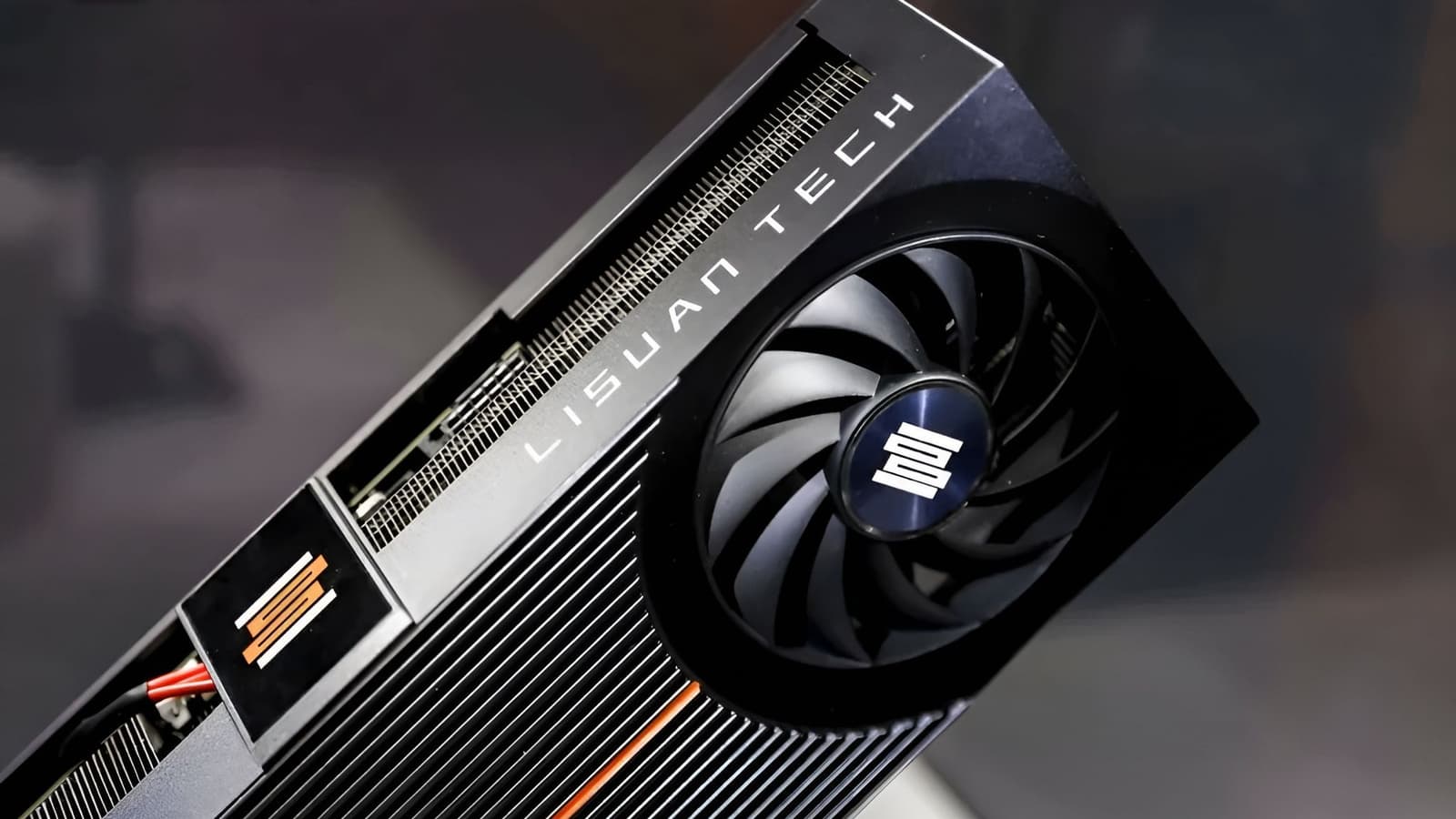
Chinese GPU maker Lisuan has started shipping its G100-series Lisuan 7G106—manufactured on TSMC N6—with mass production beginning September 2025 and retail availability in China expected in Q1 2026. The 7G106 is specified with 12 GB GDDR6 on a 192-bit bus, PCIe 4.0 x16, 192 TMUs, 96 ROPs, a 225 W TDP (single 8‑pin), and an NRSS upscaler positioned against DLSS/FSR; early tests place its performance at mid-range NVIDIA/AMD levels. Initial shipments target professional users (digital twin workloads) rather than gamers, signaling a credible domestic competitor that could alter GPU competition and supply-chain dynamics in the Chinese market.
Market structure: A domestically produced Lisuan G100 (6nm, 12GB GDDR6) directly threatens mid-range GPU unit share in China — estimate 10–25% of China’s mid-range (”60”-class) unit sales could flip to domestic SKUs within 12–24 months if drivers and pricing hold. Winners: TSMC (TSM) as contract foundry, Chinese system integrators and memory (GDDR6) buyers; losers: NVDA and AMD in the Chinese retail/professional mid-market where pricing power is weakest. Expect modest downward pressure on mid-range ASPs (-5% to -15% over 12 months) and increased implied volatility in NVDA/AMD options around Q1 2026 retail launch.
Risk assessment: Key tail risks include a) US export controls or sanctions on TSMC tooling/EDA that could halt production (low prob, high impact), and b) weak driver/software (NRSS) adoption that keeps performance perception poor. Near-term (days–weeks): minimal market moves; short-term (weeks–months): watch mass-production signals and benchmarks into Q1 2026; long-term (12–36 months): potential structural share loss in China if government procurement and ISV support accelerate. Hidden dependency: reliance on TSMC N6 and third-party memory; software ecosystem (games, professional ISVs) is the gating factor.
Trade implications: Tactical trades should be asymmetric hedges rather than outright large shorts against NVDA/AMD. Favored plays: small long in TSM (direct beneficiary) and protective puts on NVDA/AMD sized to <2% portfolio risk ahead of Q1 2026. Consider pair trade long TSM vs short AMD by notional 1:1 to express foundry benefit while hedging semantic market risk; use expiries 3–9 months around retail ramp to capture re-rating.
Contrarian view: Consensus overstates immediate threat to datacenter/high-performance GPUs (CUDA lock-in, HBM-based AI cards unaffected). The market may underappreciate driver/ecosystem risk — if NRSS fails, Lisuan could underperform and create a bleed for domestic vendors. Historical parallel: previous Chinese CPU/GPU attempts captured OEM quotas but failed in gaming ecosystem; outcome hinges on ISV certification and government procurement mandates. Monitor pricing moves >10% and first independent benchmarks as decisive signals.
AI-powered research, real-time alerts, and portfolio analytics for institutional investors.
Request DemoOverall Sentiment
mildly positive
Sentiment Score
0.32
Ticker Sentiment
