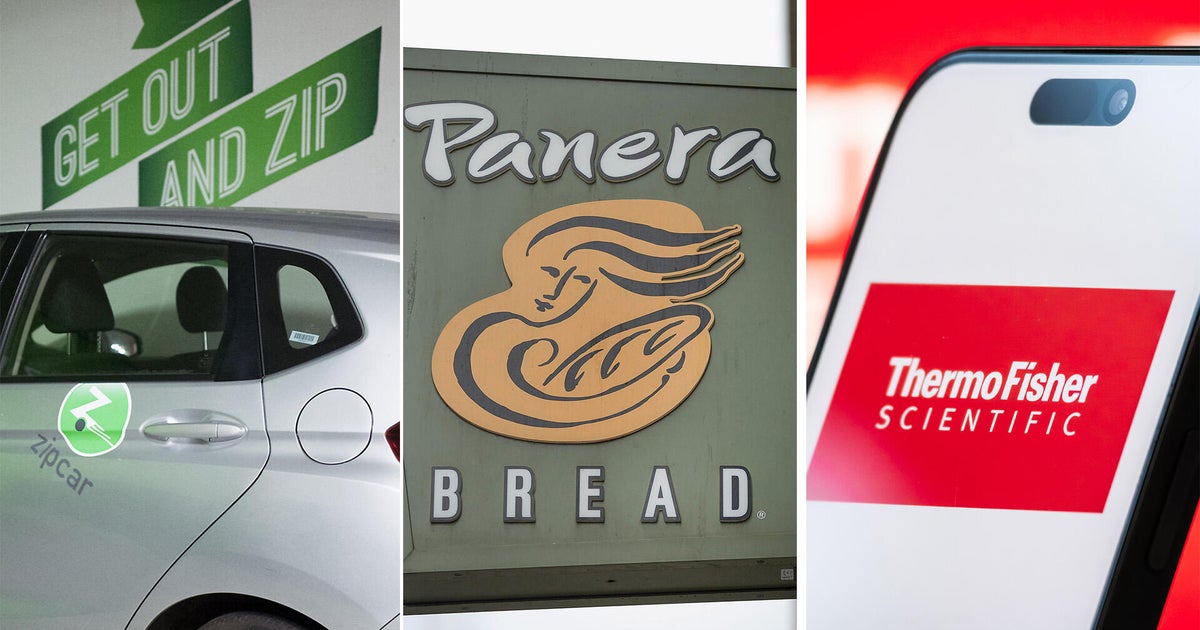
Panera, Thermo Fisher Scientific and Zipcar are closing Massachusetts facilities or offices, triggering layoffs that the article frames as affecting about 250 workers overall but with WARN filings showing specific impacts of 92 roles at Panera’s Franklin bakery (closure March 27), 103 at Thermo Fisher’s Franklin site (staggered layoffs through Dec. 31, 2027 with an eventual facility closure), and 126 Zipcar positions (65 Boston-based, 61 remote) with cuts starting April 1; separately, the Cape Cod chips plant in Hyannis is closing with 49 layoffs. Panera is shifting to a nationwide model sourcing half‑baked products from external bakeries, Zipcar (Avis-owned) is consolidating corporate operations to New Jersey while retaining regional fleet teams, and Thermo Fisher cited sector funding slowdowns despite revenue growth. The moves indicate operational consolidation and cost rationalization with localized labor and supplier impacts rather than immediate large-scale demand shocks, posing limited near-term market risk but potential implications for regional suppliers and real estate.
Market structure: These WARN-driven closures are micro shocks, not structural demand breaks — winners are large frozen/par-bake bakers and centralized fleet/consolidation teams; losers are small regional bakeries, local occupiers and discretionary-exposed mobility services. Thermo Fisher (TMO) faces demand volatility from biotech funding slowdowns which can compress OEM margins and reorder cycles; Zipcar/Avis (CAR) consolidations should modestly reduce corporate SG&A but not materially change fleet economics.
Risk assessment: Primary tail risk is a deeper, multi-quarter pullback in biotech R&D funding that reduces instrument and reagent purchases by >5-10% YoY, which would hit TMO revenue guidance within 3-9 months and justify multiple compression. Near-term (days–weeks) volatility will track earnings and funding headlines; medium-term (3–12 months) risk is execution on relocations/closures raising one-time charges. Hidden dependencies include long-term supply contracts for par-baked inputs and MA municipal sentiment if more layoffs cluster.
Trade implications: Trade tactically — hedge TMO downside with 9-month put protection while selectively buying exposure on any >8–12% drop; consider a small short in CAR via a 3–6 month put spread to capture consolidation-execution risk. Rotate out of small-cap life-science suppliers and regional retail real-estate exposure into large-cap diversified lab suppliers (TMO/DHR) and defensive consumer staples (GIS, KMB) for 6–12 month horizon.
Contrarian angles: The headline layoffs (≈250 workers) are tiny relative to issuer scale — market may overprice execution risk in TMO; historically (2016–2019) life-science funding dips caused transient share-price drawdowns followed by re-rating when instrument spend normalized. If TMO misses guidance, buying on a 10–15% drop is a high-IRR contrarian play; conversely, if biotech funding worsens materially, downside could exceed 20–25%.
AI-powered research, real-time alerts, and portfolio analytics for institutional investors.
Request DemoOverall Sentiment
moderately negative
Sentiment Score
-0.35
Ticker Sentiment
