

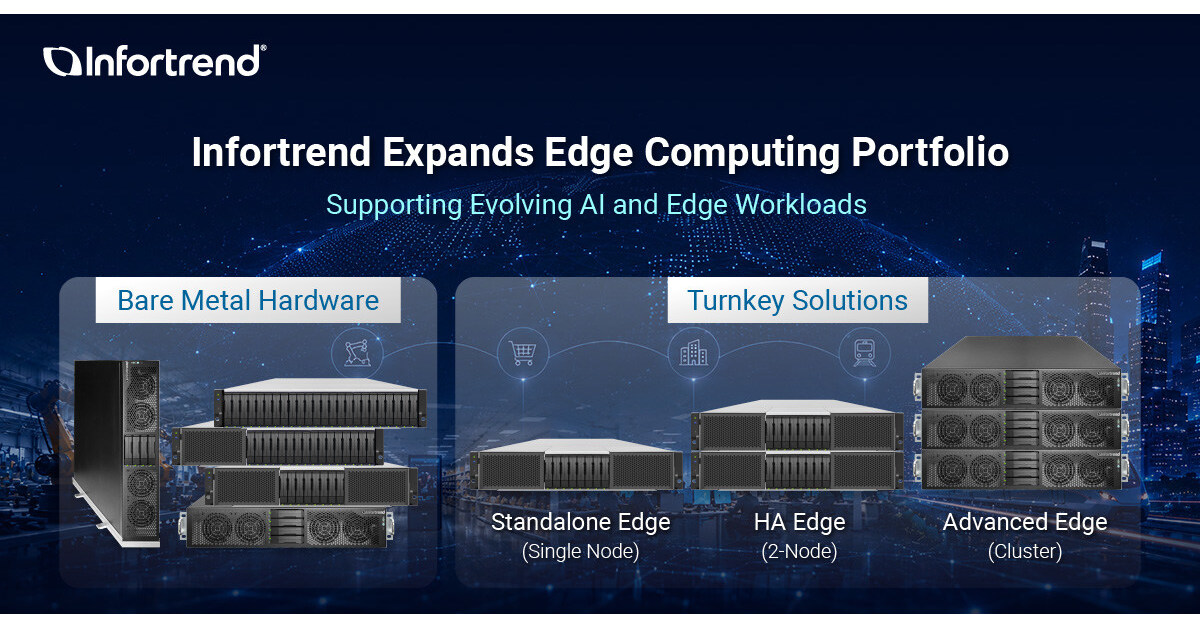
Infortrend a élargi son portefeuille d’informatique de périphérie pour soutenir des charges de travail d’IA à l’edge, allant de déploiements standalone à des clusters HA (2 nœuds) et Advanced (3-5 nœuds). Les offres incluent du matériel “bare metal” et des solutions clés en main préconfigurées, basées notamment sur des gammes KS 3000U (AMD EPYC 8004, jusqu’à 2 GPU) et KS 5000U (jusqu’à 320 cœurs, jusqu’à 4 cartes graphiques). L’annonce est globalement porteuse pour la thématique edge/IA mais sans chiffre financier communiqué, avec un impact boursier attendu limité.
This is more an ecosystem signal than a company-specific catalyst: edge-AI demand is broadening, but the revenue pool is likely to accrue first to whoever owns the appliance bill of materials and the inference software layer, not to a single CPU vendor. AMD looks modestly better positioned than INTC because compact, power-constrained deployments favor higher core density and watt efficiency, but the attach rate is still the key variable; if the workload is accelerator-led, CPU upside compresses quickly.
Near term, the market should treat this as a sentiment-positive datapoint for server/edge infrastructure rather than a fundamental step-function. Over 1-3 months, the relevant catalyst is whether other OEMs and channel partners start echoing similar edge product expansion, which would indicate a real procurement cycle in industrial, retail, and remote-site inference. If that does not show up in bookings or backlog, the news fades into the AI marketing noise.
The bigger second-order effect is on mix, not volume: edge nodes can be lower ASP but higher margin if bundled with services, while also pulling forward replacement cycles for older x86 boxes in distributed locations. That said, the total addressable market remains fragmented, and many customers will default to the cheapest acceptable configuration, which limits pricing power for both AMD and INTC.
Contrarian view: consensus may be overestimating how quickly edge AI translates into semiconductor revenue. Most deployments will likely be small pilots with long qualification cycles, and the winner is often the systems integrator rather than the silicon supplier. For INTC, this is a reminder that its installed base keeps it in the conversation, but not yet proof of share gain; for AMD, it supports the narrative, but not enough to justify a re-rating without evidence of design-win conversion.
AI-powered research, real-time alerts, and portfolio analytics for institutional investors.
Request TrialOverall Sentiment
mildly positive
Sentiment Score
0.15
Ticker Sentiment
