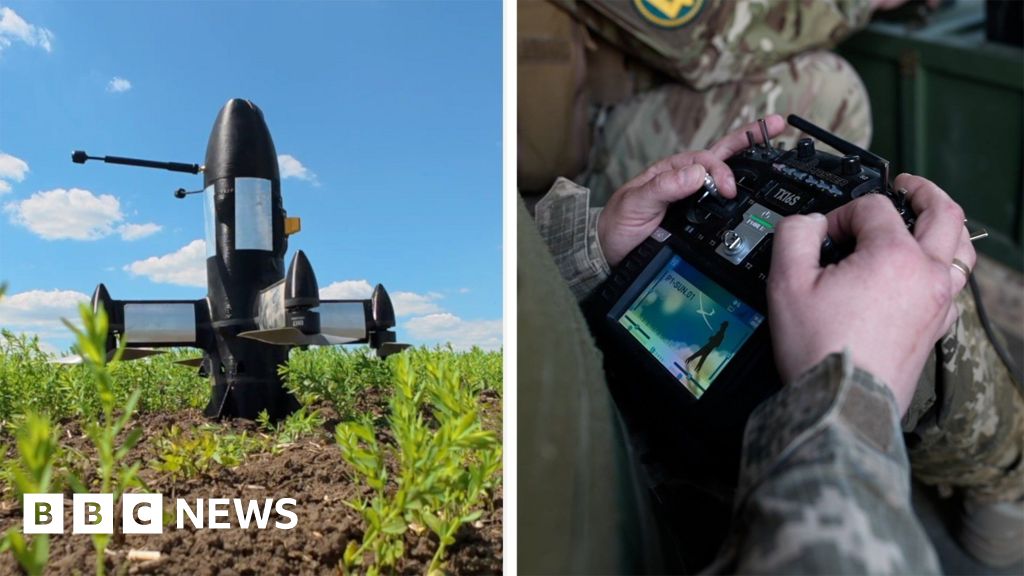
Ukraine says it intercepted 94% of long-range drones and 73% of missiles in Russia's latest mass aerial assault, but the attacks still killed civilians and exposed ongoing air defense gaps. The article highlights rapid advances in layered defenses, including AI-driven Sky Map software and cheap interceptor drones that Ukraine is now producing at more than 1,000 per day, alongside private-sector participation from 25 companies. Despite progress, Ukraine still lacks enough Patriot missiles to counter ballistic threats, leaving the air war highly volatile.
Ukraine is moving from a capital-intensive air-defense model to a software-and-volume model, which is strategically more scalable and economically asymmetric. That matters because the defender’s cost curve is collapsing faster than the attacker’s: cheap interceptors, distributed sensors, and private-sector participation create a persistent margin squeeze on Russian drone saturation tactics. The second-order effect is that Russia is being forced to spend up the value chain on decoys, jet-powered drones, and more complex strike packages just to preserve the same penetration rate.
The bottleneck is no longer tactical ingenuity but scarcity of top-tier interceptors and the ability to defend against ballistic and FPV threats simultaneously. That creates an ugly allocation problem for Ukraine: every Patriot round fired at a ballistic missile is one less available for the next salvo, while cheap drone defenses don’t solve the high-end threat. Over the next 1-3 months, the key risk is not a single catastrophic strike but a gradual reversion in interception rates if Western supply slackens or if Russia forces the system to triage targets more aggressively.
The contrarian point is that the market may be overestimating the durability of the ‘improving defense’ narrative and underestimating the industrial winners from this conflict. The real beneficiaries are not necessarily legacy defense primes alone, but software, ISR, counter-UAS, and autonomy vendors that can scale at low unit cost. Conversely, any company exposed to European reconstruction or Ukrainian industrial activity remains hostage to intermittent infrastructure attrition, even if headline intercept metrics look better.
AI-powered research, real-time alerts, and portfolio analytics for institutional investors.
Request DemoOverall Sentiment
mildly negative
Sentiment Score
-0.25
Ticker Sentiment
