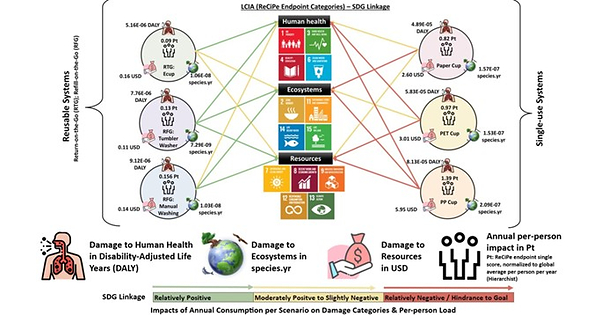
A Korea University life-cycle assessment study (published June 12, 2026) finds that reusable beverage systems’ environmental benefits depend heavily on washing efficiency—highlighting a novel automatic tumbler washer that cleans/sterilizes in 15 seconds using just 350 mL of water. When paired with stainless-steel tumblers, the automated washing system delivered the best results in over half of evaluated impact categories, while RTG reusable polypropylene cups showed the lowest overall annual impact due to lighter production footprints. The study concludes reusable cups can outperform single-use options across multiple SDG domains, but only if reuse infrastructure and operational practices (not just consumer participation) are in place.
This is not a material earnings catalyst for WM. The article is about a packaging substitution at the consumer-edge of the waste stream, while WM’s value driver is contract pricing, route density, and disposal economics; cup tonnage is too small to move that model. The more important second-order point is that reuse does not eliminate resource use — it shifts demand toward washing infrastructure, water, detergents, and sterilization capex, which is a much better read-through for equipment and utility vendors than for solid-waste haulers.
Near term, any knee-jerk ESG bid or selloff around “reusable beats single-use” is likely overstated. Even if universities and municipalities adopt these systems, the adoption curve is constrained by operating friction and behavioral compliance, so the impact on packaging volumes should be gradual and localized over 1-3 quarters, not a sudden secular break. For WM, the only plausible downside would be a long-duration reduction in commercial waste generation in dense urban accounts, but that would need visible tonnage data, not a press release, to matter.
The contrarian read is that the market often treats reuse as a clean substitution when the economics are really about infrastructure quality. That means the winners are not necessarily the companies aligned with the narrative, but the vendors that make the system operational. For WM specifically, the right stance is patience: no tradeable thesis here unless route-level volume data or municipal mandates show a step-down in waste intensity over multiple quarters.
AI-powered research, real-time alerts, and portfolio analytics for institutional investors.
Request DemoOverall Sentiment
neutral
Sentiment Score
0.10
Ticker Sentiment
