

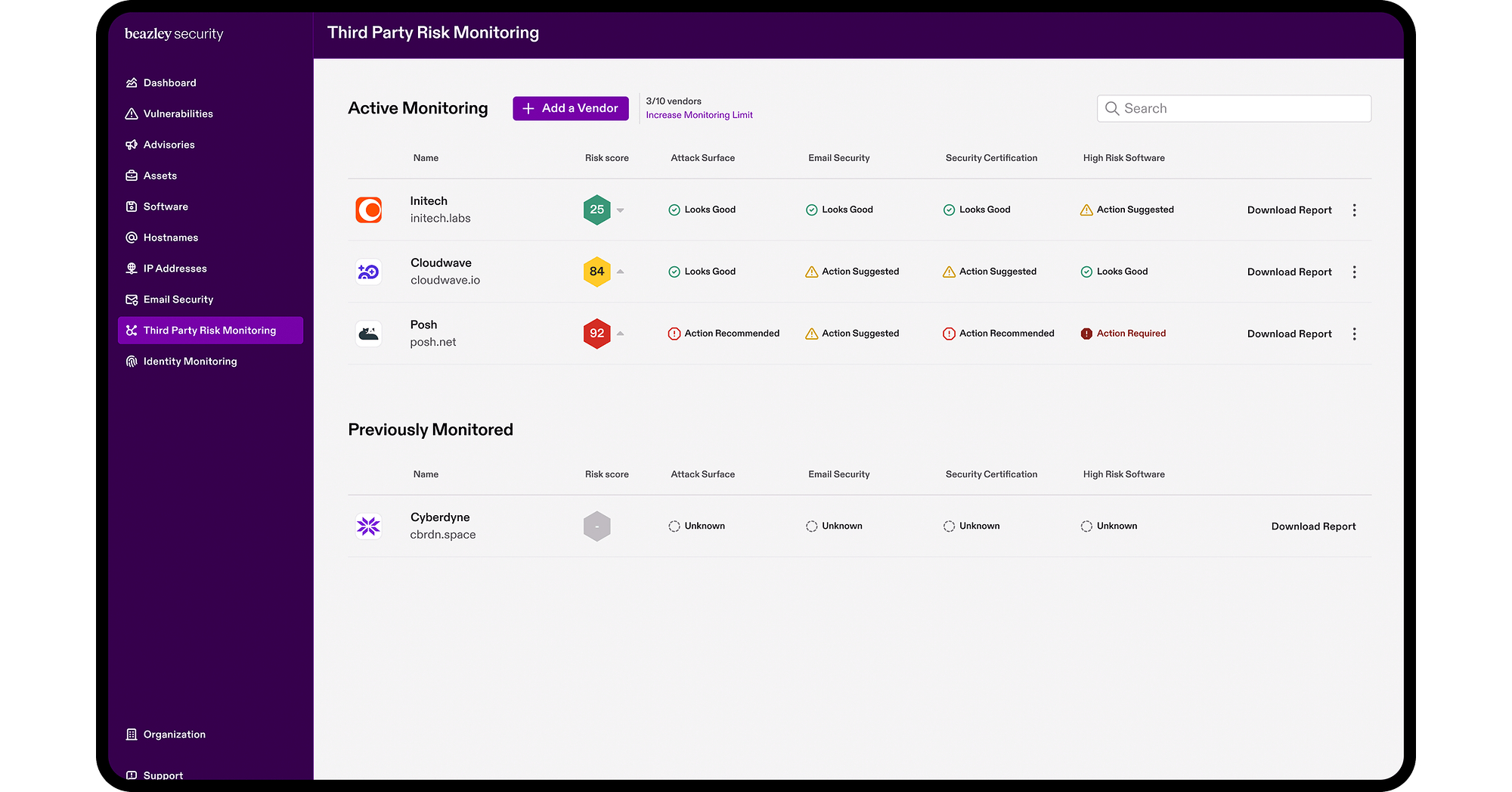
Beazley Security expanded its VERACIS Exposure Management platform with Third-Party Risk Monitoring (TPRM) and Dark Web Monitoring (DWM), adding continuous 0–100 vendor risk scoring and dark-web credential exposure detection. The upgrades target two fast-growing cyber entry paths—weak third-party vendor links and stolen credentials from breaches/malware/underground marketplaces. News is product-focused with limited direct financial implications near term, but it strengthens the company’s security platform positioning for breach and ransomware prevention.
This is strategically more important for underwriting than for near-term software revenue. The real option value is a tighter feedback loop between incident data, client hardening, and cyber pricing: if Beazley can prove that exposure telemetry reduces claim frequency/severity, that should show up in better retention and a lower cyber loss ratio over 6-18 months, not in the next quarter’s P&L. The market is likely to overread the product launch as a growth story when the bigger lever is margin protection inside the insurance book.
Competitive spillover is more interesting. Continuous vendor-risk and credential monitoring pushes the industry away from static questionnaires and toward continuous telemetry, which disadvantages advisory-heavy TPRM shops and standalone breach-monitoring vendors with weak workflow integration. It also raises the bar for cyber insurers: carriers that cannot connect exposure management to underwriting will have a harder time differentiating on renewal, especially in mid-market accounts where bundling security support can reduce churn.
The contrarian view is that the launch is probably too small to matter as a standalone revenue driver, so chasing BZLYF on this headline is low conviction. The hidden bull case is data accumulation: if Beazley uses these modules to improve pricing discipline and reduce claims drift, that can compound quietly in the loss ratio. Falsifiers are simple: no measurable improvement in cyber underwriting metrics over the next 2-4 quarters, or evidence that clients treat this as a low-switching-cost feature with no retention benefit.
AI-powered research, real-time alerts, and portfolio analytics for institutional investors.
Request TrialOverall Sentiment
mildly positive
Sentiment Score
0.15
Ticker Sentiment
