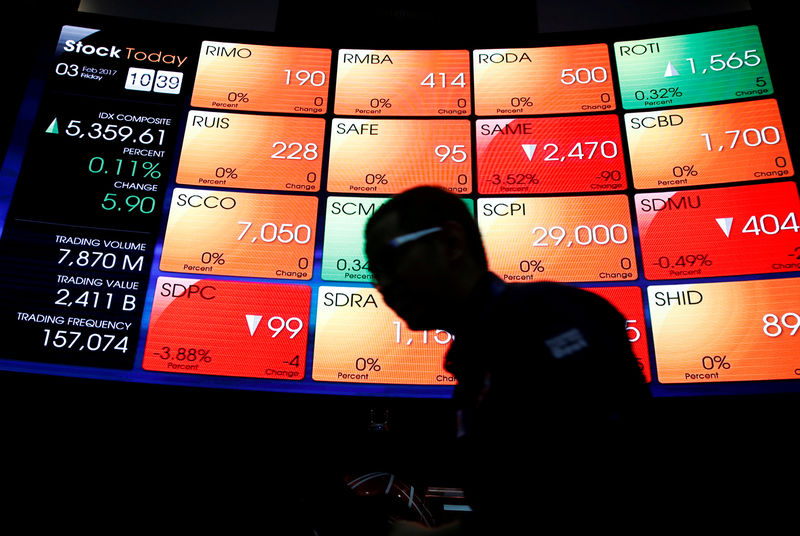
Fresh U.S. attacks on Iran helped drive oil higher, with Brent up 3.00% to $96.22 a barrel even as U.S. crude for July fell 4.04% to $92.70. Indonesia's IDX Composite slipped 0.85%, led lower by Financials, Agriculture and Basic Industry, while decliners outnumbered advancers 473 to 239. FX was weaker for the rupiah, with USD/IDR up 0.43% to 17,791.20 and AUD/IDR up 0.17% to 12,741.15.
The key market read-through is not the headline move in crude, but the asymmetry in regional risk premia: when geopolitical escalation hits a major shipping corridor, energy prices can reprice instantly while local equity markets and currencies absorb the slower, second-round shock. Indonesia is exposed through imported fuel inflation, a weaker trade balance, and higher funding costs for domestically leveraged sectors; financials and consumer cyclicals usually see the first earnings estimate cuts because margin compression shows up before explicit demand weakness.
The FX move matters as much as the equity tape. A softer rupiah against a still-firm dollar environment raises imported-input costs and can force the central bank into a tighter-for-longer stance, which is negative for rate-sensitive sectors even if headline commodity exporters get a temporary lift. The second-order winners are not broad commodity producers, but firms with pricing power, dollar-linked revenues, or low fuel intensity; the losers are transport, retail, and balance-sheet-heavy domestics that cannot pass through costs quickly.
The contrarian risk is that the market may be overpricing a lasting supply disruption while underpricing a fast diplomatic de-escalation. If the geopolitical premium fades over days rather than weeks, crude can give back a large fraction of the move, but the FX and risk-premium damage to EM assets often lingers longer than oil itself. That argues for trading the dislocation through relative value rather than outright directional exposure.
For global energy, the more durable trade is a basket of names with low lifting costs and strong free-cash-flow conversion, not high-beta refiners or small-cap E&Ps that need a sustained spot spike to work. In Indonesia specifically, this setup is bearish for domestic banks and consumer discretionary unless oil stays elevated long enough to bleed into subsidy policy and inflation expectations. The best tactical opportunities are in hedges that monetize volatility crush if the conflict headline premium fades.
AI-powered research, real-time alerts, and portfolio analytics for institutional investors.
Request DemoOverall Sentiment
mildly negative
Sentiment Score
-0.15
