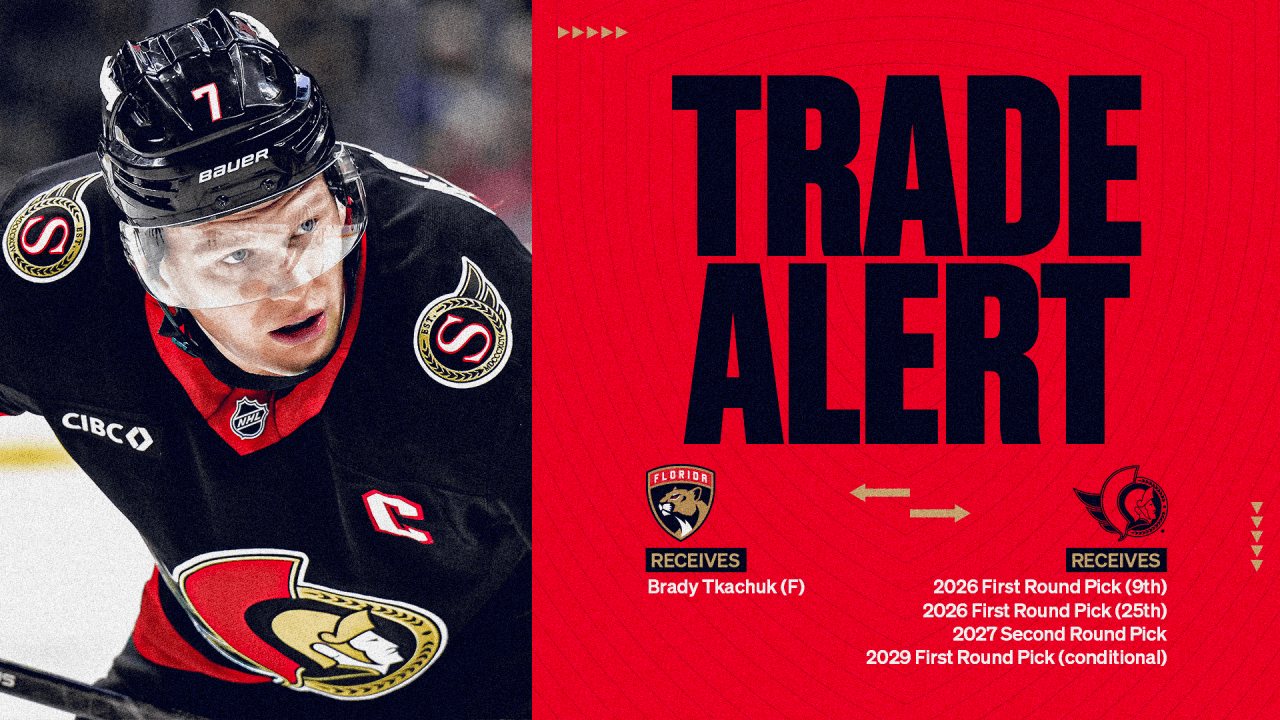
Florida acquired forward Brady Tkachuk from Ottawa in exchange for three first-round draft picks and one second-round pick, including a top-10 protected 2029 first. Tkachuk brings 463 career points in 572 NHL games, 59 points in 60 games last season, and five straight seasons as Ottawa captain. The move materially strengthens Florida’s roster but is unlikely to have broad market impact beyond hockey-related sentiment.
This is a classic contention-window trade: Florida is paying future draft capital for present-day certainty, which usually signals a team that thinks its championship probability is unusually concentrated in the next 12-24 months. The second-order effect is not just roster improvement but bracket compression: the move raises the floor on Florida’s playoff identity by making their forecheck and net-front game harder to scheme against, which tends to matter more in the postseason than in the regular season. That also creates a substitution effect across the East, where teams built on finesse or transition scoring now face a more punishing matchup profile.
The hidden cost is optionality. A top-10-protected future first is effectively a low-probability tail risk, but the other two premium picks are real opportunity cost if the team experiences any aging, injury, or cap friction over the next two seasons. If performance dips before the draft capital fully amortizes, the deal becomes a leverage bet with poor liquidation value because physical, high-usage forwards can age sharply once their pace or availability erodes. In other words: the upside is front-loaded, the downside is back-loaded.
For Ottawa, this is less about a rebuild and more about a reset of organizational time horizon. Premium picks are valuable only if they coincide with a coherent development cycle; if not, they become diluted assets that never fully convert into impact players. The market likely underestimates how much captaincy and emotional gravity matter in a room—replacing that type of player usually requires multiple transactions, not one.
Contrarian angle: the consensus will frame Florida as the obvious winner, but the larger edge may be that Ottawa has increased its probability of being bad enough to keep all of the unprotected upside while still retaining flexibility to pivot. The real risk to the bullish Florida narrative is not on-ice fit; it is cumulative wear and injury. A power-forward acquisition looks optimal when healthy, but these players often create the most value in the exact areas where availability is hardest to sustain.
AI-powered research, real-time alerts, and portfolio analytics for institutional investors.
Request DemoOverall Sentiment
mildly positive
Sentiment Score
0.40
