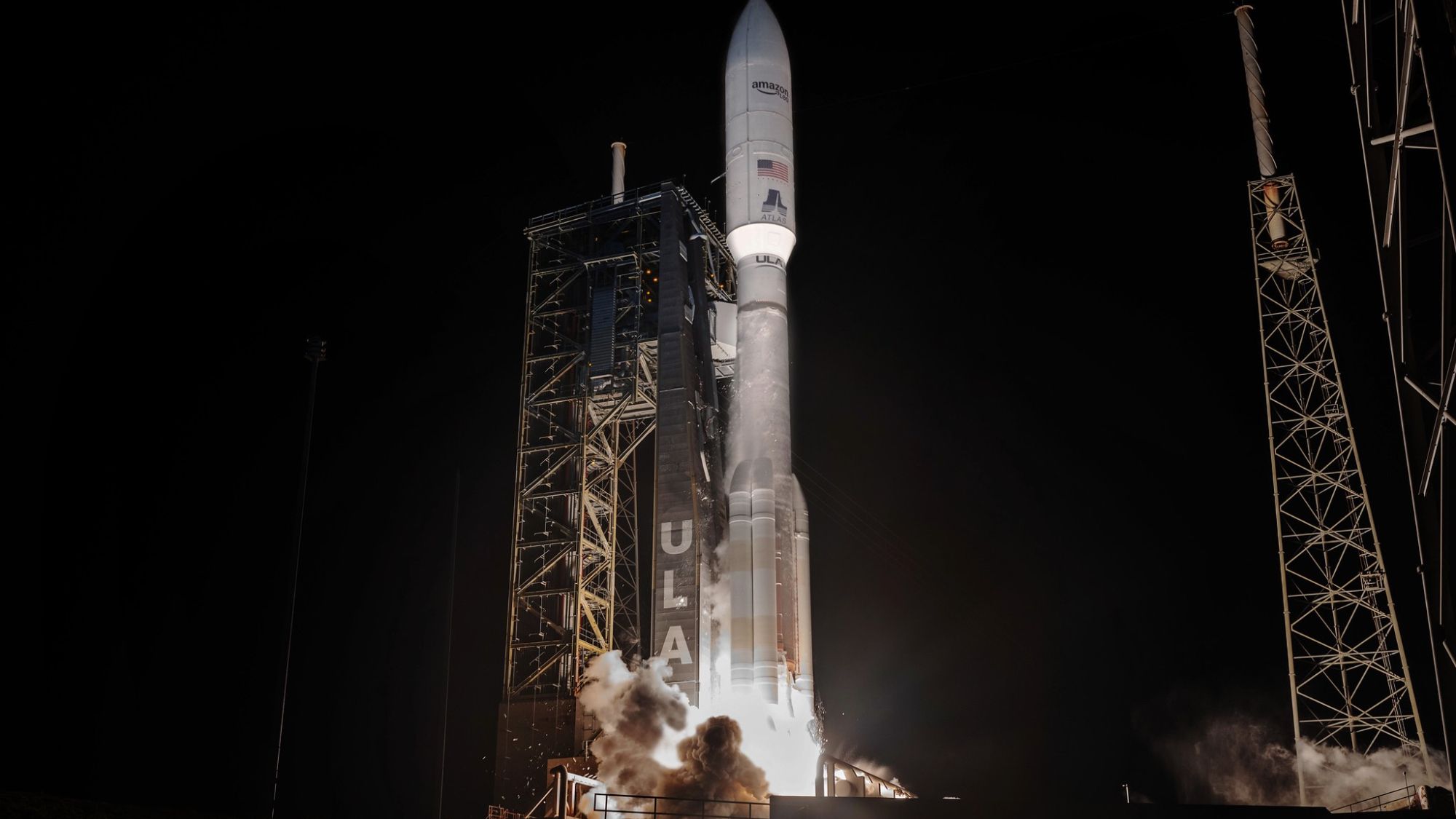
ULA's Atlas V is scheduled to launch 29 Amazon Leo internet satellites tonight from Cape Canaveral during a 29-minute window opening at 8:52 p.m. EDT. This will be the sixth Atlas V mission supporting Amazon's broadband constellation, which is planned to exceed 3,200 satellites and requires more than 80 launches overall. The article is primarily a launch update with no material financial or business surprise.
The important signal is not the single launch; it is the cadence. A steady stream of multi-satellite deployments reduces program execution risk and, more importantly, increases the probability that Amazon reaches a credible service-launch window before competitors can lock in enterprise and government contracts. In satellite broadband, “late but reliable” is often enough to win share if the customer values redundancy, bundle pricing, and procurement optionality rather than pure first-mover advantage.
The second-order beneficiary is the launch ecosystem, not just AMZN. Repeated heavy-lift missions with a stable manifest improve ULA’s utilization and bargaining power with the Pentagon and commercial customers, while also validating the broader reusability-and-heavy-payload economics that can pressure niche launch providers. For SpaceX, the competitive issue is subtler: Amazon’s buildout forces Starlink to spend more aggressively on customer retention and capacity, which can compress near-term monetization even if the competitive moat remains intact.
For AMZN, the near-term equity impact is likely modest, but the strategic value compounds over 12–36 months if the constellation moves from construction to service and starts cross-selling into AWS, enterprise networking, and logistics connectivity. The market may still underappreciate how much of the optionality is on distribution and bundling rather than subscription ARPU alone; if Amazon can package connectivity with cloud, devices, and global logistics, the addressable profit pool is materially larger than a standalone ISP model.
The key risk is operational slippage: any launch cadence miss, regulatory delay, or satellite reliability issue can push revenue recognition back by quarters and embolden rivals to sign long-term contracts first. The contrarian view is that the market may be overpricing the strategic importance of the constellation in the near term — the real P&L contribution is likely years away, so the best trade may be on launch-enabler names and on volatility around execution milestones rather than a straight bullish AMZN expression.
AI-powered research, real-time alerts, and portfolio analytics for institutional investors.
Request DemoOverall Sentiment
neutral
Sentiment Score
0.05
Ticker Sentiment
