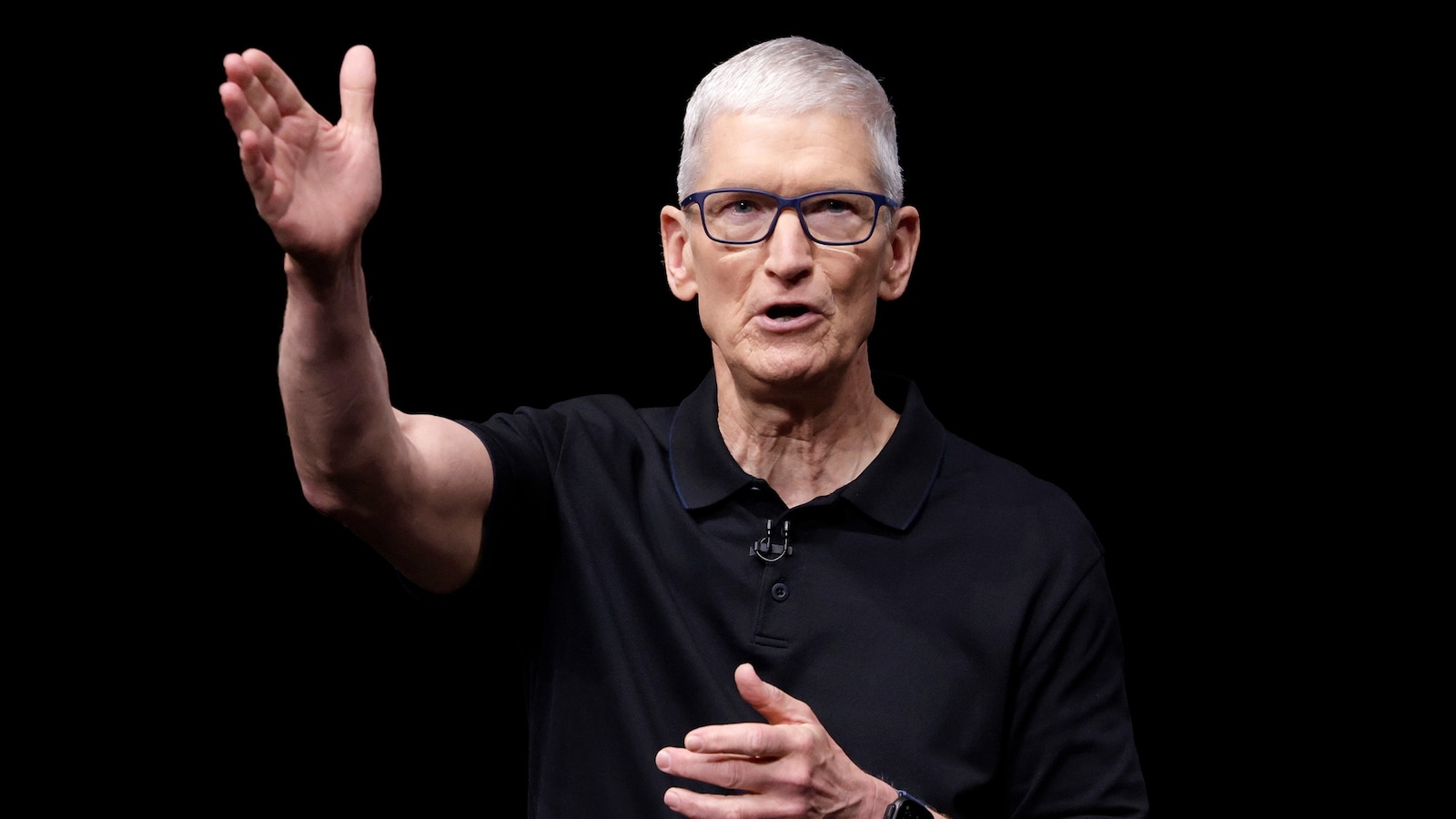
Apple announced that CEO Tim Cook will step down on Sept. 1 and be replaced by John Ternus, who will become CEO while Cook moves to executive chairman. Cook has led Apple since 2011, during which the company said its market capitalization grew from about $350 billion to $4 trillion. The change is a major leadership transition, but the article provides no evidence of operational disruption or immediate financial impact.
This is less a disruptive event than a controlled handoff, which matters because Apple’s equity premium is built on continuity of execution, not founder-style multiple expansion. The market should treat the appointment as a governance de-risking event, but the larger implication is that capital allocation and product cadence now sit more squarely with an engineering-led operator whose upside will be judged on hardware-cycle discipline rather than narrative charisma. That tends to compress upside volatility in the near term while reducing the probability of strategic missteps over a 12-24 month horizon.
The second-order effect is on the ecosystem: suppliers with concentrated Apple exposure should benefit if the transition preserves the existing roadmap, but they also lose the optionality that comes with a more aggressive “new category” push. If Ternus emphasizes product reliability and incremental refreshes, the winners are likely the high-quality component vendors tied to iPhone/iPad/Wearables mix and the losers are higher-beta adjacency names that trade on speculative category expansion. Competitively, that favors incumbency over disruption; Android OEMs and mixed-reality challengers only gain if the market interprets the move as a sign Apple is becoming more conservative in platform bets.
The key risk is not the succession itself but the first 6-9 months of messaging: any sign of internal factionalism, delayed AI strategy, or slower product innovation would matter more than the CEO title change. Conversely, if Ternus quickly signals continuity on margins, buybacks, and product timing, the stock can re-rate back to fundamentals within weeks because the “key-man” discount should be small. The contrarian read is that the transition may be mildly bullish for the multiple: markets often overprice founder-transition risk, and a technically credible operator can reduce uncertainty around the most important thing in Apple — execution consistency.
AI-powered research, real-time alerts, and portfolio analytics for institutional investors.
Request DemoOverall Sentiment
neutral
Sentiment Score
0.10
Ticker Sentiment
For trading, the event looks better suited to relative-value expressions than outright longs because the upside from a smooth handoff is likely modest while the downside from any communication stumble is asymmetric. The cleanest setup is to buy Apple on any post-announcement weakness and pair it against a basket of supplier names that are most exposed to a perceived slowdown in product ambition, or against an index weight that has less governance overhang. Time horizon matters: the stock reaction should be measured in days, but the real signal will emerge over the next 2-3 product cycles if Ternus demonstrates that Apple can sustain innovation without Cook’s capital-allocation hand.
