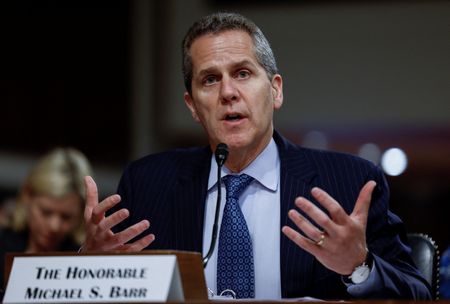
Fed Governor Michael Barr warned that stress in private credit could create psychological contagion and potentially trigger a broader credit crunch, despite direct bank links still not looking worrisome. He flagged insurance-sector overlaps and said investor sentiment shifts could lead to a credit pullback, adding that the banking system is strong but current deregulation trends weaken safeguards. Fed Chair Powell has also said officials are monitoring private credit but do not yet see systemic risk.
The market is underpricing how quickly “private” stress can become a public-factor de-rating event for financials without an obvious bank failure. The key transmission channel is not direct loan losses, but forced retrenchment: if lenders tighten terms, refinancing windows close, and secondary market marks gap lower, the effect ripples into levered credit beta, small-cap financing, and any portfolio dependent on sponsor capital. That makes the near-term risk less about systemic collapse and more about a slow-motion liquidity tax that compresses multiples across risk assets.
Second-order winners are the highest-quality public credit allocators and balance-sheet lenders that can wait out dislocation. Banks with minimal private-credit exposure and strong deposit franchises should gain share as borrowers seek certainty, while insurers with opaque private-credit sleeves face a credibility discount if mark assumptions are challenged. The bigger loser set is not just private lenders, but also small-cap operating companies that rely on incremental credit availability; tighter underwriting would hit buybacks, capex, and M&A simultaneously, which tends to show up first in Russell 2000 relative underperformance before it appears in headline credit spreads.
The main catalyst window is weeks to months, not years: if another bankruptcy or valuation markdown lands, sentiment could shift faster than fundamentals because the asset class is already crowded in illiquid, mark-to-model structures. The contrarian view is that the market may be over-focusing on headline contagion risk and underestimating the policy backstop; regulators can lean on bank capital, insurers, or disclosure long before a true systemic event. That means the trade is likely a relative-value expression rather than a broad risk-off macro short, unless private credit dispersion becomes visible in funding markets.
AI-powered research, real-time alerts, and portfolio analytics for institutional investors.
Request DemoOverall Sentiment
moderately negative
Sentiment Score
-0.30
