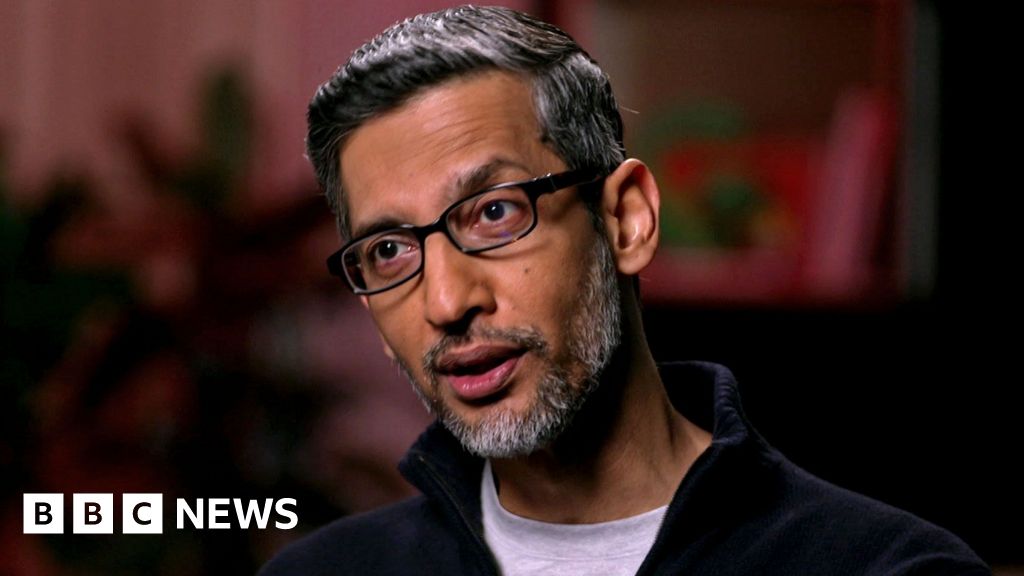
Alphabet CEO Sundar Pichai warned that the current trillion‑dollar AI investment boom contains “elements of irrationality” and that no firm would be immune if a bubble bursts, even as markets have driven Alphabet’s market value to about $3.5tn after a seven‑month rally and rival Nvidia reached roughly $5tn; analysts point to a tangled $1.4tn of OpenAI‑related deals despite OpenAI’s projected revenues this year being under one‑thousandth of planned investment. He said Google’s vertically integrated “full‑stack” model — from chips to data and models — gives it resilience, and highlighted a £5bn, two‑year UK investment to expand research and onshore model training. Pichai also flagged material operational risks: AI’s growing energy footprint (about 1.5% of global electricity last year) has slowed progress on climate targets and will require new energy and infrastructure investment, while the technology will reshape jobs and necessitate workforce adaptation.
Alphabet CEO Sundar Pichai told the BBC that the current trillion-dollar AI investment boom contains "elements of irrationality" and warned no company would be immune should a bubble burst. Markets have driven Alphabet's market value to about $3.5tn after a seven-month rally while rival Nvidia recently reached roughly $5tn, underpinning elevated valuations. Analysts flagged a complicated web of roughly $1.4tn of deals related to OpenAI even though OpenAI's projected revenues this year are said to be less than one‑thousandth of planned investment, prompting dotcom-era comparisons and Greenspan-like "irrational exuberance" concerns.
Pichai argued Alphabet's vertically integrated "full-stack" model—covering chips, YouTube data, models and frontier science—positions it to better weather market turbulence, and the company committed £5bn to UK AI infrastructure and on‑shore model training over two years. He nonetheless conceded that no firm is immune and emphasized execution risk if investment overshoots economic fundamentals.
He flagged material operational constraints: AI consumed about 1.5% of global electricity last year, causing slippage on Alphabet's climate timelines and creating a need for new energy and infrastructure investment. These factors imply potential margin and capex pressure, a greater probability of valuation re-rates if revenue proof-points lag investment, and a clear need for investors to monitor capex, energy disclosures and deal-to-revenue metrics as early warning indicators.
AI-powered research, real-time alerts, and portfolio analytics for institutional investors.
Request DemoOverall Sentiment
mixed
Sentiment Score
0.00
Ticker Sentiment
