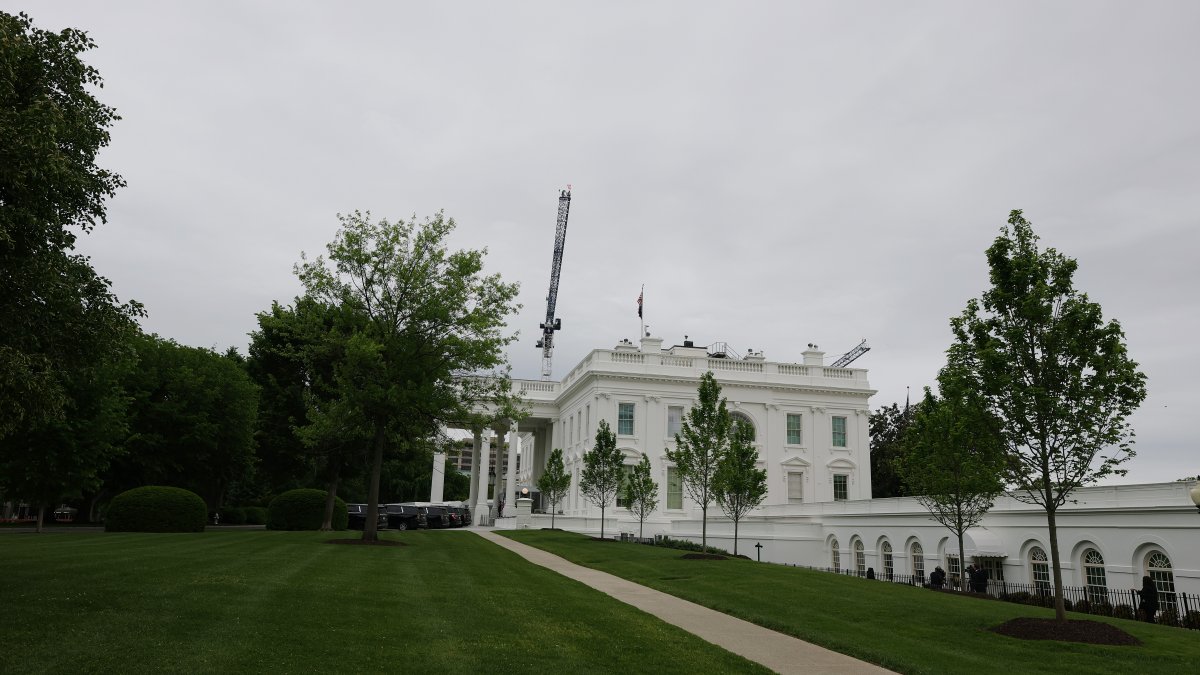
Senate Republicans added $1 billion for White House security upgrades to a bill funding immigration enforcement, a move tied to President Trump’s ballroom project. The proposal would fund Secret Service security adjustments and above-ground/below-ground security features, though not non-security elements, while the White House says the project could be heavily fortified. The measure is politically contentious but is unlikely to have broad market impact beyond headlines around federal spending and litigation over the project.
This is less about the White House project itself and more about a near-term read-through for ICE. The added security line item makes the broader DHS package politically more attachable in the Senate, but it also raises the odds of horse-trading that slows final passage or forces offsets elsewhere. For ICE specifically, the market should treat this as a modest negative on timing rather than on magnitude: if funding is delayed into the next budget fight, procurement visibility slips and the stock’s narrative loses a catalyst, even though multi-year enforcement demand remains intact.
Second-order, the amendment signals that immigration enforcement funding is being bundled with high-salience executive-branch security spending, which increases the probability of legal challenges and procedural friction. That matters because ICE is already a politically reflexive name; any perception that funding is being pushed through via maneuver rather than consensus tends to widen headline-driven volatility and compress multiple expansion. The risk window is days to weeks around Senate action, but the larger issue is whether a future continuing resolution or court intervention resets the clock on spending authorization into the fall.
The contrarian view is that the market may be underpricing how insulated ICE is from the ballroom noise. If the bill passes, the agency gets funded and the stock likely rerates on execution; if it fails, the administration may simply repackage the same funding in a later vehicle, limiting downside beyond a short-term de-risking. In other words, this is not a fundamentals break, but a catalyst-delay trade, which usually favors buying weakness only after headline volatility peaks.
For non-ICE names, the bigger implication is that defense/security contractors with white-house, perimeter, surveillance, or hardened-facility exposure could see incremental budget attention, but this is likely too idiosyncratic to move large caps materially unless followed by a broader federal-security spending push.
AI-powered research, real-time alerts, and portfolio analytics for institutional investors.
Request DemoOverall Sentiment
neutral
Sentiment Score
-0.05
Ticker Sentiment
