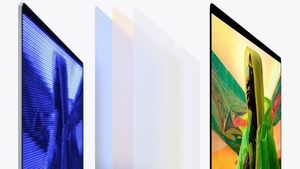
Apple is expected to shift the 2026 MacBook Pro from mini-LED to OLED, marking the first major display change in nearly two decades and requiring about 2 million panels from Samsung Display's A6 line. Samsung's 8.6-generation OLED facility has reached mid-80% yields and is positioned roughly two years ahead of BOE in IT OLED, supporting premium laptop adoption. The article highlights a potential commercialization breakthrough for large-area OLED, with per-panel costs moving toward LCD levels and implications for future laptop OEM adoption.
This is less a one-product story than a supply-chain re-rating event for premium IT OLED. If Apple certifies the large-generation panel, it creates an external quality standard that accelerates adoption across the rest of the notebook market and pushes capital toward the one proven scale node, not the highest-capacity node. That means near-term economic rents accrue disproportionately to the incumbent with yield leadership, while the strategic value of “being first” rises because qualification becomes the bottleneck, not wafer supply.
The second-order effect is that China’s capacity advantage matters less until it clears the reliability hurdle. In display, customers do not buy lowest-cost sheet output; they buy long-duration warranty confidence, which means a two-year technology lead can persist far longer in premium tiers than in smartphones. The real monetization risk for Korea is not an immediate loss of Apple volume, but a gradual margin compression if Chinese players use lower tiers to absorb learning curves and then back up the stack once field data de-risks the process.
For Apple, OLED is mildly positive on product halo but likely neutral to slightly negative on gross margin near term because the first few cycles will carry supplier concentration and qualification friction. The bigger upside is strategic: thinner, lighter Macs strengthen the ecosystem moat and may improve iPad/Mac substitution within the premium lineup, but that is a 12-24 month share story, not an immediate EPS catalyst. The stock market may underappreciate how much of this benefit is already embedded in the hardware refresh narrative versus the slower-moving margin implications.
The contrarian take is that the market may be overrating the speed of Chinese displacement and underrating the durability of a standards monopoly. If Apple becomes the reference customer, Samsung Display can defend pricing longer than consensus expects, and the biggest beneficiary of scale may be the Korean supply chain rather than the end OEM. Watch for any slip in yields or field reliability, because that would push the adoption curve back by 1-2 product cycles and quickly de-rate the entire IT OLED theme.
AI-powered research, real-time alerts, and portfolio analytics for institutional investors.
Request DemoOverall Sentiment
mildly positive
Sentiment Score
0.25
Ticker Sentiment
