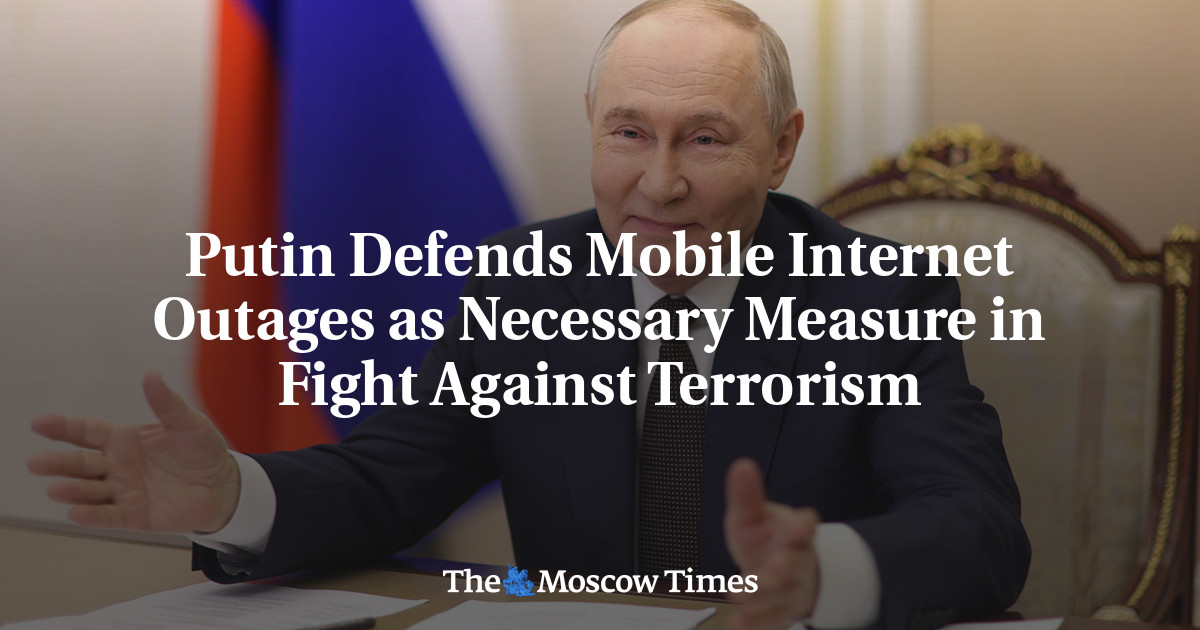
Putin defended Russia’s expanding mobile internet blackouts as necessary to prevent terrorist attacks, while ordering closer coordination with security services to keep a government-approved “white list” of services running. The disruptions have intensified in recent months, with monitoring groups saying most regions now face daily outages, and the Kremlin is also pushing to curb VPN use. The article signals tighter digital controls and ongoing internet restrictions, but it does not point to an immediate direct market-moving event.
The market implication is not the headline internet disruption itself, but the institutionalization of a segmented Russian internet. Once outages are normalized and a state-sanctioned white-list becomes the default operating layer, the economic cost shifts from episodic inconvenience to a persistent tax on digital productivity, ad conversion, app engagement, and SME commerce. That is structurally negative for any consumer-facing platform that depends on open-network behavior, while beneficiaries are the state’s preferred rails: banks, domestic messaging, and compliance-heavy software vendors.
MAX is the clearest relative winner, but the more important read-through is that its utility is policy-derived rather than product-derived. That means adoption can be forced up mechanically in the short run, yet monetization quality may remain weak because users will treat it as a survival tool, not a preferred platform. The second-order effect is that every additional restriction on VPNs and foreign messengers increases the value of domestic cyber-control infrastructure, logging, content filtering, and enterprise mobility management, creating a longer-duration budget tail for local IT/security contractors.
Risk is asymmetric over months, not days. In the near term, more outages and tighter VPN enforcement can still accelerate migration into state-approved channels, but that also increases user workarounds, gray-market distribution, and reputational damage to domestic tech. The main catalyst that could reverse the trade is a policy shift toward “managed continuity” if the economic drag becomes visible in retail activity, banking uptime, or regional labor productivity. Until then, this is a slow-burn regime shift with low headline volatility but compounding operating friction.
The contrarian view is that the market may overestimate the direct monetization upside for domestic platforms and underestimate the broader drag on digital throughput. A white-list internet can actually reduce total time spent online and weaken ad load, transaction frequency, and developer activity even if installed app counts rise. In other words, MAX may win distribution but still fail to capture the full value of the captive user base if trust and engagement decay.
AI-powered research, real-time alerts, and portfolio analytics for institutional investors.
Request TrialOverall Sentiment
mildly negative
Sentiment Score
-0.25
Ticker Sentiment
