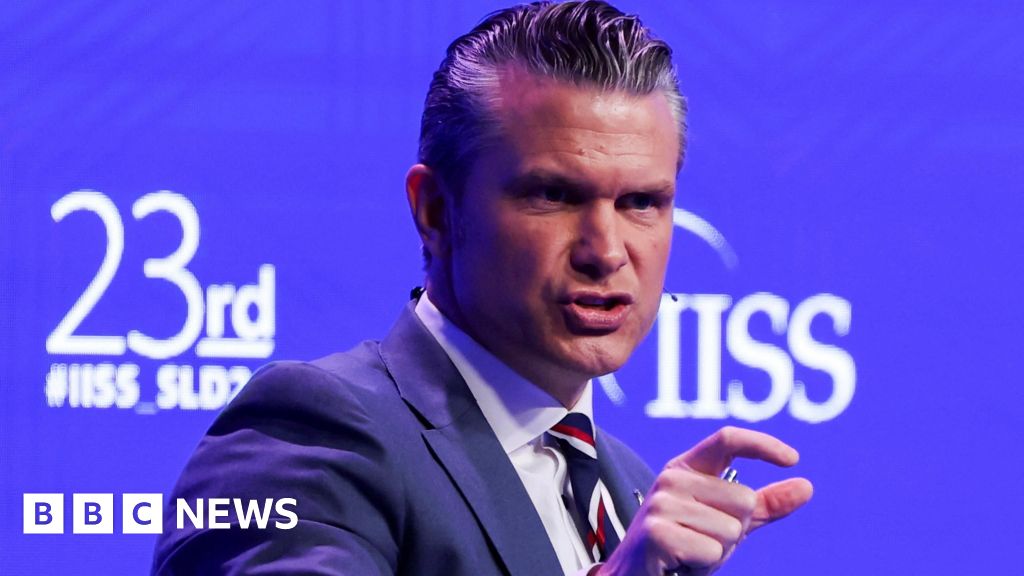
Pete Hegseth reaffirmed that the US is not "turning its backs" on Asia, while urging regional allies to lift defense spending to 3.5% of GDP and buy more weapons. He also said Washington is decoupling a suspended $14bn Taiwan arms package from munitions needs tied to the Iran war and emphasized a "measured and deliberate strength" posture toward China. The article signals continued US security commitment in Asia, but with pressure on allies for higher defense budgets and more military procurement.
The market implication is not a broad risk-on or risk-off shock, but a slow re-pricing of Asia defense capex as a more durable budget line rather than a one-off response to headlines. The key second-order effect is that US ally burden-sharing makes procurement less politically fragile: Japan, South Korea, Australia, and the Philippines are more likely to move from episodic orders to multi-year inventory, ISR, air-defense, and munitions replenishment cycles. That favors primes and select subcontractors with Pacific exposure, but even more so the suppliers of constrained components—propulsion, seekers, powders, energetics, and shipbuilding inputs—where backlog visibility can improve faster than top-line consensus.
The Taiwan-arms-package angle matters less for the specific package than for signaling around US industrial base capacity. If Washington is explicitly separating regional commitments from munitions inventory management, then the bottleneck shifts from strategic intent to production throughput, which is bullish for the defense supply chain and defense-capex enablers. Expect margin pressure for low-tier suppliers with fixed-price contracts and weak execution, while companies with pricing power and capacity expansion upside should see multiple support over the next 6-18 months.
The contrarian read is that softer rhetoric on China reduces near-term escalation premium, which could cap the fastest-momentum geopolitical longs in the short run. That creates a better entry window on defense after any pullbacks: the thesis is not immediate conflict, but a persistent structural uplift in allied spend and inventory normalization. Tail risk is a diplomatic thaw or US budget constraints that force rhetoric without procurement follow-through; the other risk is that allies promise higher spend but delay actual orders, pushing the trade from a 1-2 quarter catalyst into a 2-3 year one.
AI-powered research, real-time alerts, and portfolio analytics for institutional investors.
Request DemoOverall Sentiment
neutral
Sentiment Score
-0.05
