




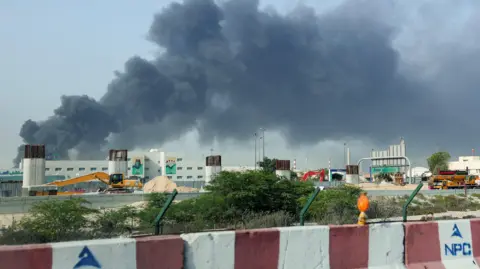
Major technology firms including Amazon, Google, Snap and Nvidia have activated safety protocols and shifted regional staff to remote work as US-Israel–Iran hostilities escalate in the Middle East; Amazon reported drones struck AWS facilities in the UAE and Bahrain and has been assessing corporate offices, fulfilment centres and delivery operations. Nvidia says it currently has no supply-chain disruptions but is monitoring operations, while analysts expect companies may temporarily pause new investments — heightening near-term operational and geopolitical risk for tech exposure in the region.
Market structure: Near-term winners are energy producers, defense/security contractors, and cloud providers with geographically diversified footprints (e.g., MSFT) as capital rotates to perceived safe infra and oil hedges; losers are regionally exposed operators (AMZN logistics/AWS regional sites, local office landlords) and travel/real-estate plays in Gulf hubs. Pricing power will shift modestly—insurance, security and site-redundancy costs will raise marginal capex by an estimated 3–8% for big tech projects in the region over 12–24 months, compressing returns on new greenfield investments.
Risk assessment: Tail risks include a Strait-of-Hormuz disruption (low-probability, high-impact) sending Brent >$100/bbl within days and triggering a global growth shock, or widespread cloud outages/cyberattacks that damage trust in a specific provider. Immediate effects (days) are operational pauses and stock vega spikes; short-term (weeks–months) are guidance revisions and capex delays; long-term (quarters–years) are reallocation of data-centre footprints and higher insurance premia. Hidden dependencies include local grid resilience and third-party connectivity (power/subsea links) that can create concentrated single points of failure.
Trade implications: Tactical: favor NVDA long exposure (resilient supply comments) and energy longs if Brent breaches $85/bbl; tactically trim AMZN equity and buy short-dated downside protection (6-week puts) to monetize near-term risk-off. Use pair trades (long MSFT or GOOGL vs short AMZN) to express cloud-share resilience while neutralizing broader tech beta. Options: deploy defined-cost instruments—3-month NVDA call spreads, 6-week AMZN 5% OTM puts, and 3–6 month XLE call spreads to capture directional moves with controlled capital.
Contrarian angles: Consensus may over-penalize AMZN — AWS Middle East is small relative to global revenue so put IV may be rich and mean-revert within 2–6 weeks; NVDA may be underpriced for continuity of AI spend despite regional shocks. Historical parallels (regional conflicts in 1990s/2000s) show short-lived dislocations followed by accelerated spending on security and redundancy that benefits large incumbents; consider asymmetric option structures to capture reversion while hedging a rare systemic escalation.
AI-powered research, real-time alerts, and portfolio analytics for institutional investors.
Request TrialOverall Sentiment
moderately negative
Sentiment Score
-0.45
Ticker Sentiment
