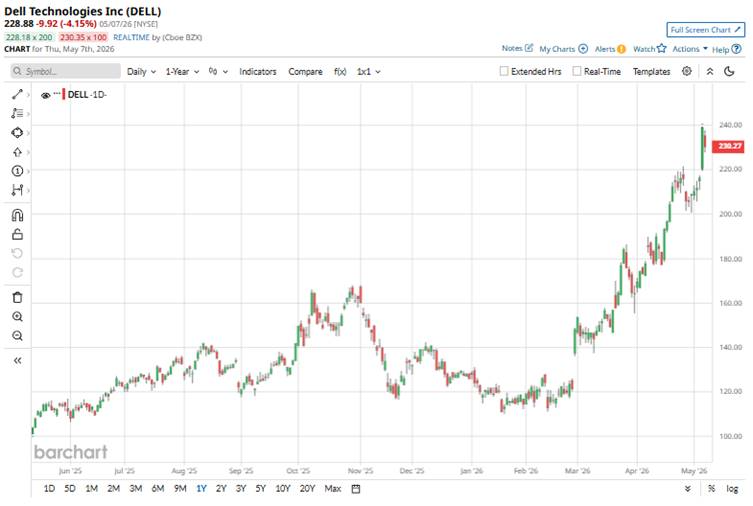
Dell is benefiting from surging AI infrastructure demand, with Mizuho lifting its price target to a Street-high $260 and management guiding fiscal 2027 AI server revenue to about $50 billion, more than double prior levels. Q4 revenue rose 39% year over year to a record $33.4 billion, while AI-optimized server revenue reached roughly $9 billion and backlog stood at $43 billion. Shares have already gained 94.32% year to date and 154.22% over the past 52 weeks, but the new analyst upside case suggests further room to run.
The market is increasingly treating Dell less like a PC cyclical and more like a toll collector on the AI capex cycle. The key second-order effect is that backlog conversion should keep visibility unusually high for the next 2-4 quarters, which can support multiple expansion even if near-term growth decelerates from peak rates. That said, the current setup creates a “good news is already owned” problem: when expectations move from demand inflection to execution perfection, any supply constraint, mix disappointment, or delayed enterprise deployment can trigger a sharp de-rating despite still-strong fundamentals.
The more interesting beneficiary set is not the obvious GPU ecosystem, but the adjacent winners in power, cooling, networking, and high-end memory/storage content per rack. Dell’s AI server growth implies more spend flowing to component vendors with tighter supply and better pricing power, while also pressuring lower-end server OEMs that lack enterprise relationships or systems integration capability. If Dell keeps taking share, the incremental losers are traditional IT resellers and general-purpose server vendors whose growth may look fine on the surface but whose mix and gross margin will deteriorate as AI racks cannibalize legacy configurations.
The risk is temporal rather than structural: over the next 1-3 months, the stock is vulnerable to any sign that the backlog is not as liquid as the headline implies, or that working-capital intensity rises faster than cash conversion. Over 6-12 months, the bigger risk is that AI server demand normalizes from hypergrowth to merely strong growth while the multiple remains priced for scarcity value. Consensus may be underestimating how quickly capital intensity and competitive pricing can eat into the earnings leverage once the initial land-grab phase moderates.
Net: the trend is still bullish, but the asymmetry has shifted from “own the breakout” to “own the pullback.” The cleanest expression is to stay constructive while using rallies to fade upside tail-risk, because the valuation already embeds a lot of the next year’s operating momentum. If enterprise AI spend broadens beyond a handful of hyperscale names, Dell can continue compounding; if not, the stock can mean-revert faster than the fundamentals would suggest.
AI-powered research, real-time alerts, and portfolio analytics for institutional investors.
Request DemoOverall Sentiment
strongly positive
Sentiment Score
0.78
Ticker Sentiment
