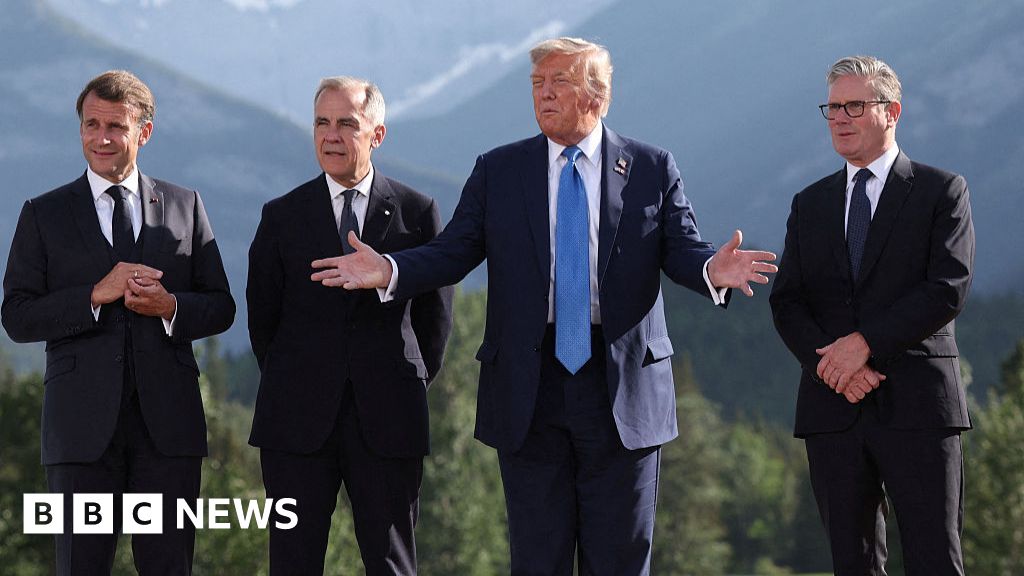
US allies, including Canada, France, and the UK, are signaling a significant diplomatic shift by announcing plans to recognize a Palestinian state under certain conditions, diverging sharply from the Trump administration's steadfast support for Israel. This coordinated move, underscored by a conference boycotted by the US, aims to fill a strategic vacuum regarding Gaza's future governance and peace, driven by escalating humanitarian concerns and a perceived absence of a coherent US long-term plan. The development highlights a growing chasm within Western powers on a critical geopolitical issue, potentially altering the trajectory of the Israeli-Palestinian conflict and regional stability.
A significant diplomatic schism is emerging between the United States and its key G7 allies, including Canada, France, and the UK, over the future of the Israeli-Palestinian conflict. This divergence is crystallized by the allies' recent announcements to recognize a Palestinian state, a move precipitated by the escalating humanitarian crisis in Gaza and the absence of a coherent long-term U.S. strategy. The Trump administration has explicitly rejected this diplomatic path, boycotting a French-Saudi-led conference as a "publicity stunt" and creating what the article terms a "strategic vacuum." U.S. policy under Trump appears to have jettisoned the prior administration's "Tokyo Principles" and now closely parallels that of Israeli Prime Minister Netanyahu, focusing on the elimination of Hamas without a clear plan for post-war governance. The administration's inability to articulate a vision, coupled with its acceleration of arms shipments to Israel, contrasts sharply with European efforts to revive the two-state solution, driven by an inflection point of widespread starvation and civilian casualties. This fundamental break in Western consensus introduces a new level of geopolitical uncertainty, as European and Arab nations attempt to forge a diplomatic path without the participation of their traditional superpower ally.
AI-powered research, real-time alerts, and portfolio analytics for institutional investors.
Request DemoOverall Sentiment
strongly negative
Sentiment Score
-0.60
