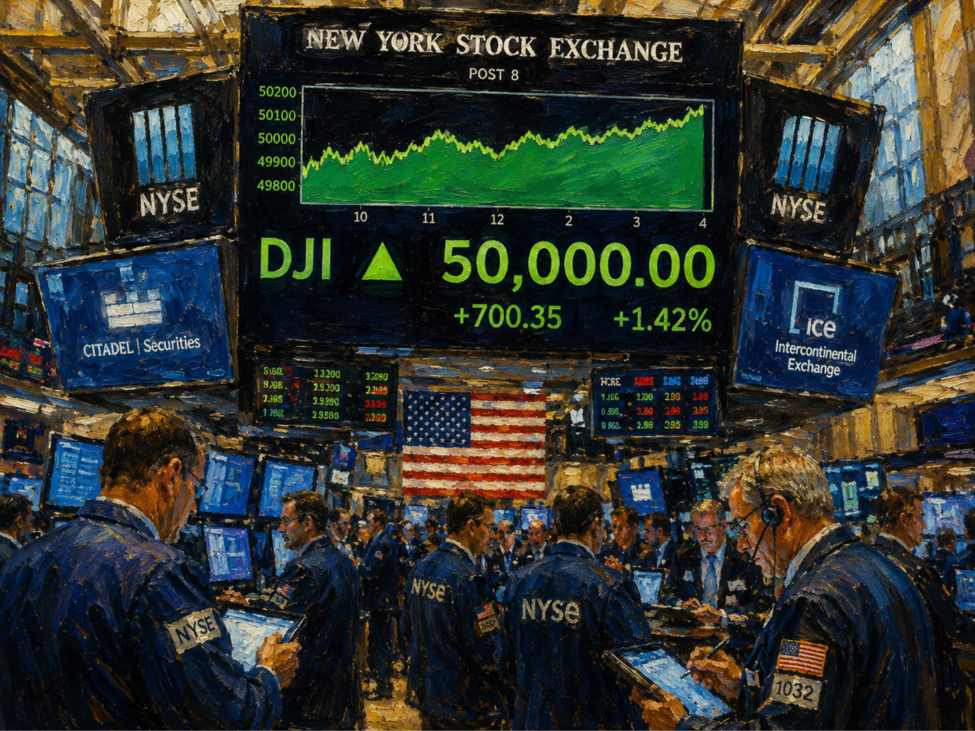
The Dow Jones Industrial Average has reclaimed the 50,000 level, briefly trading above the milestone and holding near 49,971, up about 673 points or 1.37% on the day. The index has nearly fully retraced its prior nearly 10% correction from a March 27 low of 45,166.64, while the S&P 500 and NASDAQ Composite are also higher by 1.40% and 1.88%, respectively, and on pace for record closes. Treasury yields are lower, with the 2-year down 17.3 bps to 3.865% and the 10-year down 6 bps to 4.347%, while crude oil is down $7.07 to $95.20, providing a tailwind for equities.
The important signal is not the Dow’s round-trip back to a headline level; it is the market’s refusal to price in a durable tightening of financial conditions. Lower front-end yields alongside a strong equity tape tells you the market is effectively repricing the Fed path more than it is repricing growth, which is a constructive cocktail for multiple compression reversal in cyclicals and the highest-beta laggards. In that setup, the leadership tends to broaden from a narrow mega-cap/growth cohort into rate-sensitive industrials, small caps, and financials over the next several weeks.
A sharp pullback in crude is the more subtle second-order bull case. Energy is acting as a tax cut for consumers and a margin tailwind for transport, airlines, chemicals, and discretionary retail, but the bigger effect is on inflation expectations and terminal-rate odds. If oil stays pressured for even 2-4 weeks, the market will increasingly extrapolate lower CPI prints, which can keep real yields from rising even as equities grind higher—a favorable regime for long-duration assets and multiple expansion.
The contrarian risk is that this move has the feel of a positioning squeeze rather than a clean fundamentals rerating. A fast retracement to prior highs after a near-10% drawdown often leaves the market vulnerable to a one-day reversal if rates or credit wobble, especially because breadth can look healthier right before momentum exhausts. The key tell over the next 1-3 weeks is whether lower yields come with stable credit spreads; if spreads widen while equities make new highs, this rally is more fragile than it appears.
From a tactical standpoint, the best risk/reward is to lean into rate sensitivity rather than chase the index itself. The setup favors a rotation trade: long homebuilders and small caps versus short oil-linked equities if crude remains under pressure, because the former get both cheaper financing and a demand boost while the latter face margin compression and lower reinvestment appetite. The trade works best if the market continues to treat falling yields as growth-positive rather than recessionary.
AI-powered research, real-time alerts, and portfolio analytics for institutional investors.
Request DemoOverall Sentiment
mildly positive
Sentiment Score
0.35
