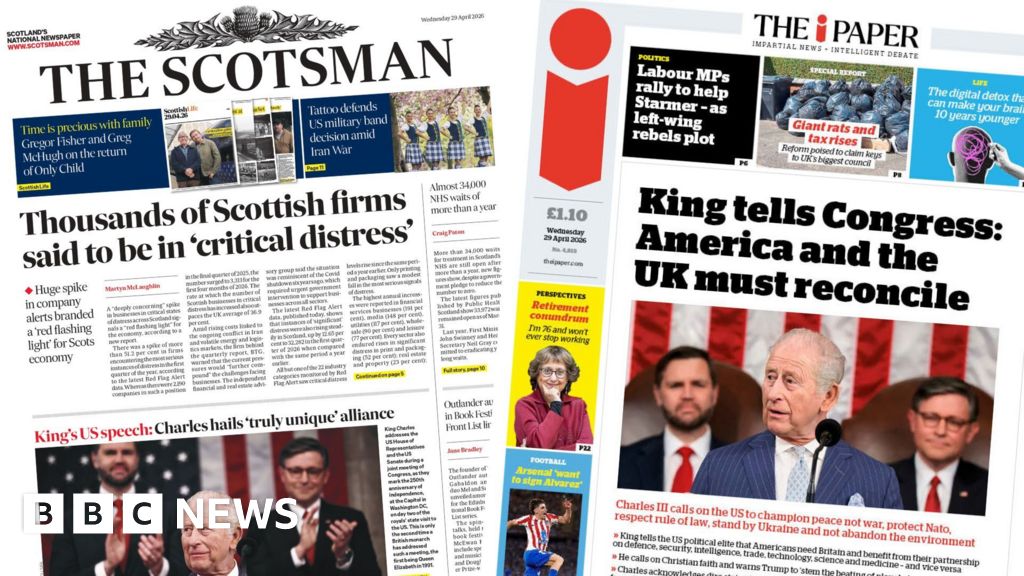
The article is a newspaper roundup with a headline referencing firms in 'distress' and the King addressing Congress, but it provides no substantive financial details, company names, or quantitative updates. As presented, it contains no clear market-moving information and reads as a general news digest rather than an investable event.
This is less a market event than a signal about late-cycle fragility: when local press starts using “distress” language, the important read-through is not headline equity beta but financing conditions for small and mid-cap UK corporates. The likely winners are balance-sheet-quality names and lenders with low single-name exposure; the losers are highly levered industrials, regionally concentrated service firms, and anyone reliant on rolling working capital lines over the next 1-2 quarters. Expect second-order stress in suppliers before it shows up in reported earnings, because payment terms and inventory cuts usually hit margins first.
For politics/geopolitics, the practical effect is more about policy optionality than immediate asset moves. A government under domestic pressure tends to prioritize visible stabilizers: credit support, energy relief, procurement acceleration, and softer enforcement on failing employers, which can temporarily support cyclicals but usually compresses returns on capital. The market usually misprices this as a “good news” liquidity bridge; the better framing is that it delays defaults without fixing demand, extending the period of subpar pricing power.
The contrarian view is that “distress” headlines often arrive near the point of maximum pessimism, when the weakest names have already de-rated and the better-run peers are about to gain share. If the macro backdrop stabilizes even modestly over the next 3-6 months, the opportunity is to own quality through the noise rather than short the entire complex. The key catalyst to watch is financing availability: if bank lending surveys tighten again, stress can cascade quickly; if they loosen, the equity downside is mostly in the weakest balance-sheet names, not the sector broadly.
AI-powered research, real-time alerts, and portfolio analytics for institutional investors.
Request DemoOverall Sentiment
neutral
Sentiment Score
-0.05
