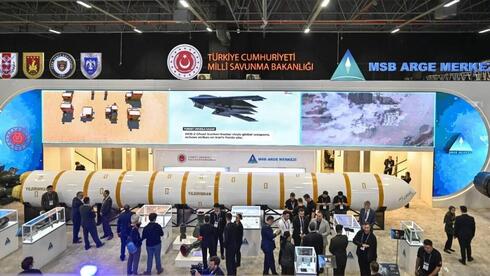
Turkey unveiled the YILDIRIMHAN, a long-range liquid-fueled ballistic missile capable of hypersonic speeds, described as the longest-range missile developed in the country to date. The launch underscores Ankara’s ongoing push to expand its domestic defense industry, alongside other locally developed systems such as the Gölgehan jamming software, Güçhan turbofan engine and PNR-35 sniper rifle. The development is strategically important for Turkey’s defense self-sufficiency, but the immediate market impact is likely limited.
This is less a single weapons announcement than a signal that Turkey is moving from “import substitution” to an indigenous export stack across air defense, propulsion, EW, and strike systems. The second-order winner is not just the prime contractor ecosystem; it is the broader local industrial base that can now amortize R&D over domestic procurement plus future Gulf, North African, and Central Asian exports. If that export thesis holds, the real margin expansion sits in test/evaluation, electronics, turbofan subsystems, and software-defined jamming — areas with higher repeatability and less geopolitical baggage than legacy platform assembly.
The trade-off is that capability growth may catalyze a regional procurement race. A more credible Turkish long-range strike posture raises the value of early-warning, interceptor, and counter-UAS layers for Greece, Cyprus, Israel, and Gulf buyers; that shifts demand toward European and Israeli integrated air-defense suppliers and away from purely platform-centric spend. It also increases Turkey’s leverage in NATO industrial talks, which can unlock dual-use capital goods and avionics access, but the U.S. F-35-style sanctions precedent remains a real ceiling if Ankara’s posture becomes more confrontational.
Near term, the catalyst path is budgetary and political rather than operational: exhibition-to-procurement conversion, foreign signing deals, and any follow-on export licenses over the next 3-12 months. The contrarian point is that hypersonic branding may be ahead of production readiness; liquid-fueled long-range systems are easier to showcase than to field at scale, so the market can overprice near-term deterrence while underpricing testing, reliability, and sanctions friction. If the program is more demonstrator than deployable weapon, the upside accrues to suppliers of subsystems and NATO-friendly countermeasures, not to a broad re-rating of Turkish defense capacity.
AI-powered research, real-time alerts, and portfolio analytics for institutional investors.
Request DemoOverall Sentiment
mildly positive
Sentiment Score
0.30
