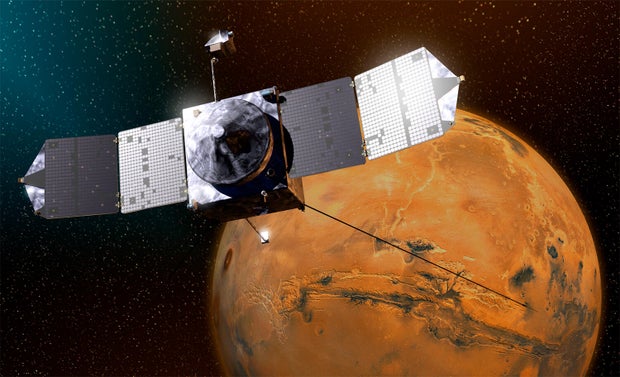
NASA has ended the $582 million MAVEN Mars orbiter mission after the spacecraft stopped communicating following a Mars occultation on December 6, 2025. Attempts to remotely restart the flight computer and reestablish contact failed, and recovered telemetry suggests the probe was rotating at 2.7 revolutions per minute, a non-survivable condition that likely drained its batteries. The loss is scientifically meaningful but has limited direct market impact.
The direct market impact is limited, but the second-order signal is more interesting: deep-space asset uptime remains a single-point-of-failure problem, which keeps mission-assurance spending sticky across civil space and defense. Any program that depends on autonomous fault recovery, long-duration radiation tolerance, or relay redundancy should see slightly better budget protection after a high-profile loss of a proven platform. The beneficiaries are less the launch providers and more the avionics, fault-management, ground segment, and space-network vendors that sell resilience rather than raw launch capacity.
For Mars operations specifically, this increases the value of redundancy in relay architecture. If a long-lived relay platform can fail unexpectedly, the burden shifts to newer orbiters and surface assets to carry communications load, which can create incremental wear, bandwidth congestion, and higher ops costs over a multi-year horizon. That is a quiet positive for companies exposed to space networking and mission software, while it is a negative for any vendor competing on single-satellite mission economics rather than constellation resiliency.
The contrarian view is that this is not a broad “space is hard” bearish event; NASA has already extracted most of the scientific value, and failure after an extended life is reputationally much less damaging than an early mission loss. So the downside for the space sector is mostly near-term sentiment, not fundamentals. The real catalyst would be if the investigation points to a systemic autonomy or thermal/power-management issue that maps onto other long-duration spacecraft programs; absent that, the trade should be viewed as a modest budget reallocation story rather than a sector-wide reset.
AI-powered research, real-time alerts, and portfolio analytics for institutional investors.
Request DemoOverall Sentiment
mildly negative
Sentiment Score
-0.15
