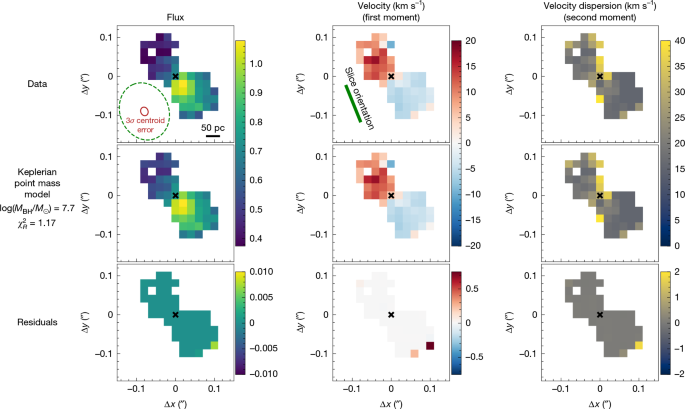
Researchers reported a direct dynamical black-hole mass measurement of about 5 million solar masses in the lensed high-redshift little red dot QSO1 at z = 7.04, using JWST/NIRSpec kinematics. The data favor a Keplerian point-mass model over extended star-cluster or dark-matter alternatives, with a best-fit black-hole mass of log(MBH/M⊙) = 7.7 ± 0.3 after inclination correction and a host-galaxy stellar-mass upper limit of <2 × 10^7 M⊙. The result supports the validity of virial black-hole mass estimates in early-universe AGN, but it is primarily a scientific breakthrough with minimal direct market relevance.
The market implication is not the headline BH mass itself; it is the validation of a measurement regime that had been treated as unstable at z>7. If direct dynamics and virial estimates are converging in a prototypical LRD, then the broader “all JWST broad-line AGN are badly overestimated” thesis weakens, which should compress the dispersion in inferred seed masses across the entire high-z sample. That matters because capital allocation to the seed-forming debate has been anchored to a binary: light-seed growth models versus heavy-seed/primordial alternatives. This result shifts the burden of proof back toward the skeptics of virial calibrations and likely reduces the upside in the most extreme overmassive-host narratives.
Second-order, the real winner is the observing stack around JWST NIRSpec IFU, lensing-assisted spectroscopy, and kinematic software rather than any individual astrophysical interpretation. If one object can be dynamically resolved at z~7, then the next 12-18 months should bring a step-up in follow-on claims on host-to-BH ratios, seed formation, and duty-cycle estimates. Expect a “re-rating” of confidence in early BH demographics: not necessarily higher masses, but narrower error bars and lower tolerance for exotic explanations that rely on broad-line pathologies alone.
The contrarian point is that the result may actually be bearish for the most sensational primordial-BH angle. A measured, fairly ordinary supermassive BH with little host stellar mass is still extreme, but it is extreme in a way that is compatible with rapid baryonic growth under a lens-selected, temporarily underluminous state. In other words, the opportunity set may be in identifying undercounted dormant or low-Eddington AGN seeds, not in pricing a wholesale rewrite of early-universe cosmology.
AI-powered research, real-time alerts, and portfolio analytics for institutional investors.
Request TrialOverall Sentiment
neutral
Sentiment Score
0.15
