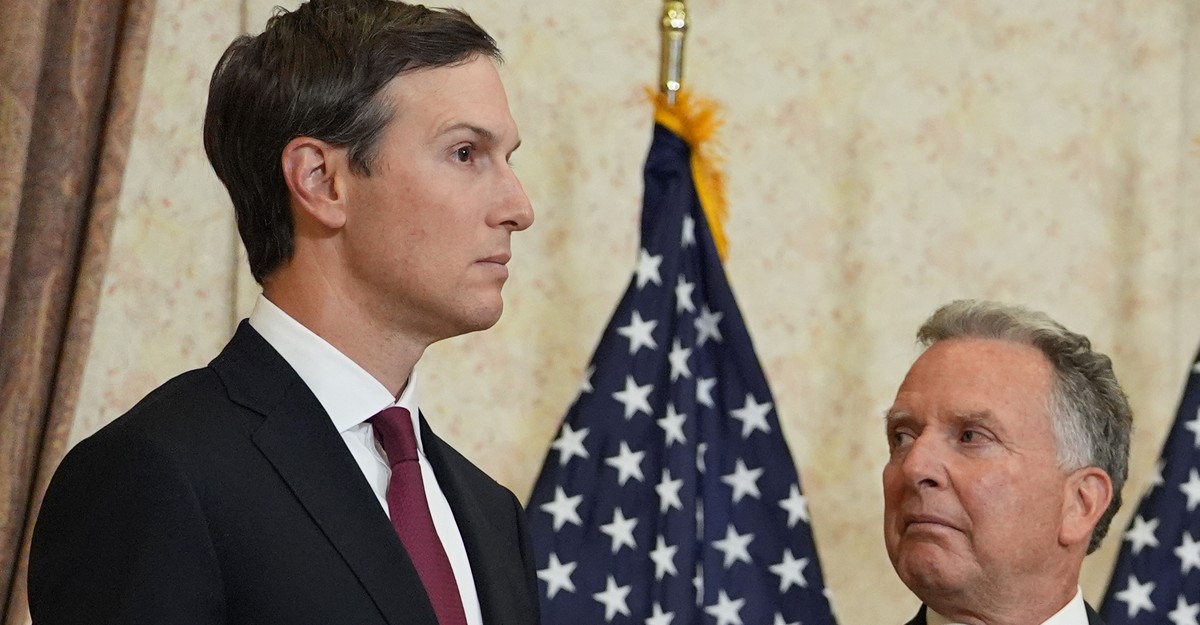
The article highlights Jared Kushner’s continued involvement in Trump administration diplomacy while running Affinity Partners, including a $2 billion Saudi-backed investment and an attempted $5 billion capital raise. The core issue is governance and conflict-of-interest risk: Kushner is performing government-like work without ethics disclosures or formal designation, raising concerns about foreign influence and transparency. The piece is primarily a political/ethics critique rather than a direct market-moving business development.
The market implication is not about one individual’s ethics headline; it’s about the erosion of process certainty in U.S. policymaking. When informal, undisclosed intermediaries become de facto diplomats, policy outcomes become harder to model and easier to steer by relationship capital, which lifts the value of assets tied to access rather than fundamentals. That favors firms with direct policy adjacency, private-market financing flexibility, and geopolitically embedded franchises, while penalizing any business exposed to rule-based procurement, sanctions enforcement, or clean disclosure norms.
Second-order, this raises the probability of abrupt policy discontinuities on the Middle East and sanctions front. The key risk is not a steady drift but a binary event: a negotiation breakthrough, a sanctions waiver, or a military escalation that changes shipping, energy, and defense inputs in days rather than months. The largest dislocation trade is likely in short-dated volatility, because the information set is intentionally opaque; that means implied vol can stay suppressed until a headline gap forces repricing.
The contrarian point is that the immediate issue may be underpriced because investors habituate quickly to governance decay. If the administration normalizes unaccountable back-channel diplomacy, the winners are not just Kushner-adjacent entities but a broader ecosystem of private capital vehicles, consultancies, and defense contractors that monetize discretionary foreign policy. The loser set is narrower but more important: institutions that depend on a credible U.S. anti-corruption framework, including compliance-heavy banks, global allocators, and any EM sovereign credits vulnerable to U.S. favor shifts.
AI-powered research, real-time alerts, and portfolio analytics for institutional investors.
Request TrialOverall Sentiment
mildly negative
Sentiment Score
-0.10
