


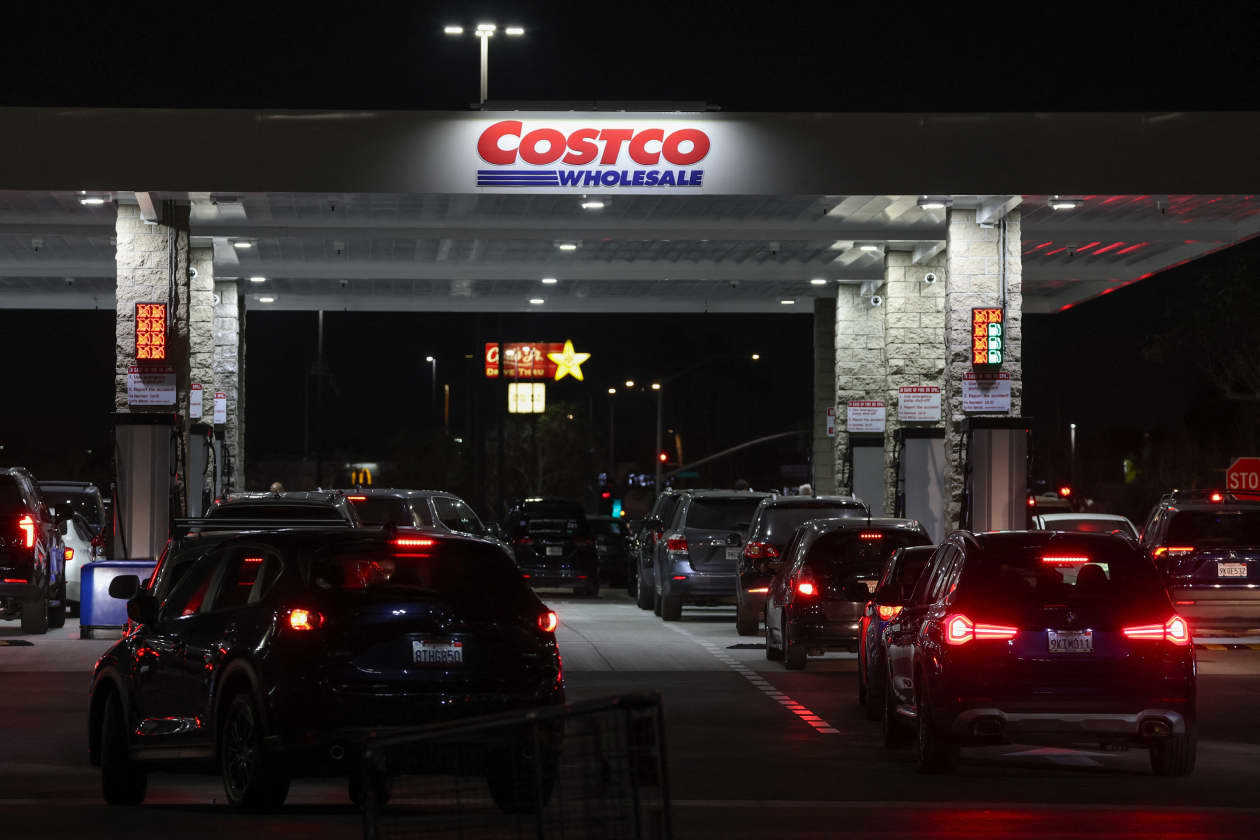
Costco’s same-store sales rose 9.8% in the third quarter, aided by higher gasoline sales and coming in above Wall Street expectations. The article frames the quarter as mixed overall, with after-hours trading muted despite the sales beat. Rising gas prices and the cost-of-living squeeze may continue to support club retailers such as Costco, Sam’s Club, and BJ’s Wholesale Club.
Rising fuel is a short-cycle traffic driver for club formats because the basket economics are now being anchored by trips, not just price perception. The second-order winner is the operator with the densest gas footprint and strongest renewal flywheel: fuel pulls members in, but the real monetization comes from higher renewal probability and more attach in discretionary categories over the next 1-3 quarters. That makes this less about gasoline margin and more about traffic reallocation from traditional grocers and lower-frequency retailers.
The market may be underestimating the asymmetry between top-line optics and margin quality. Fuel can boost comps while simultaneously compressing merchandise gross margin mix if shoppers chase lower-ticket staples and gasoline skews the sales base; that creates a “good sales, mediocre EPS” setup. For names with weaker membership economics or less differentiated gas economics, the benefit is more transitory and can fade within one quarter if pump-price momentum stalls or consumers shift back to online delivery.
The key contrarian risk is that a sustained gas spike eventually taxes the same household budget that is driving the trade-in to clubs. If fuel remains elevated for 2-4 months, the initial trip-frequency tailwind can morph into unit deflation in discretionary categories, especially big-ticket and high-margin impulse items. That matters more for chains with lower renewal momentum and less ability to cross-sell fuel into full-basket economics.
On balance, this is a relative-value story, not a blanket retail bull case. The market should reward the highest-quality club operator on a 1-2 quarter basis, but the move in secondary names is likely overdone if investors extrapolate the gas benefit into a durable demand shift. The cleanest setup is to own the structurally best membership model and fade weaker club comps that are being repriced as if all fuel traffic is equally sticky.
AI-powered research, real-time alerts, and portfolio analytics for institutional investors.
Request TrialOverall Sentiment
mixed
Sentiment Score
0.15
Ticker Sentiment
