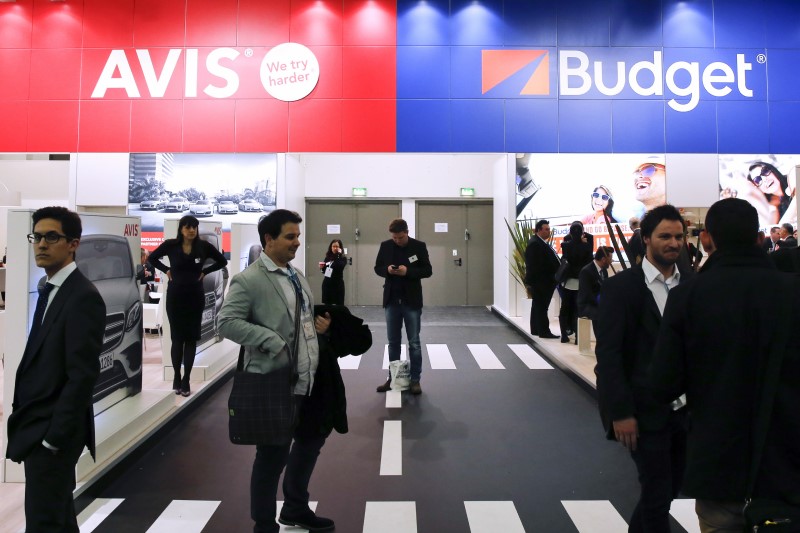
Avis Budget Group shares fell 9% Thursday after plunging 38% the prior day, as a short squeeze eased and JPMorgan downgraded the stock from Neutral to Underweight. JPMorgan raised its price target to $165 from $123, but said the shares have run far above levels justified by even the most optimistic earnings outlook. The stock is still up 340% over the past 30 days despite the two-day selloff.
The key signal here is not the downgrade itself, but the transition from forced buying to discretionary ownership. When a stock has moved this far, the next marginal seller is usually not the short but the event-driven holder monetizing liquidity, which creates a multi-day air pocket even if the fundamental story hasn’t changed. That dynamic tends to overshoot to the downside because borrow availability improves just as call-implied support disappears, and dealers unwind gamma hedges into weakness.
For CAR, the real second-order question is whether management can convert this dislocation into balance-sheet optionality fast enough to matter. If they can raise capital or refinance on advantageous terms, the equity can stay structurally elevated versus pre-squeeze levels even after the technical reset; if not, the market will likely re-rate it back toward a conventional cyclical used-car / rental multiple over the next 1-3 quarters. The risk is that the business may face the worst of both worlds: weaker residual-value assumptions from normalization plus a capital structure narrative that is now anchored to a one-time technical spike.
JPM is a small direct loser in the name, but the more important read-through is to every crowded short with a high borrow cost and call-driven upside. This is a warning that once a squeeze becomes headline-visible, implied vol and retail call demand can overshoot even on mediocre fundamentals, forcing other shorts to de-risk preemptively. That said, consensus may be underestimating how quickly these parabolic moves mean-revert once incremental catalyst flow dries up; in many squeeze cases, the post-peak drawdown is as violent as the rally within 5-10 trading sessions.
The contrarian view is that the squeeze may have created a one-time financing window rather than a permanent valuation reset. If management is opportunistic, equity dilution could actually be accretive to enterprise value by lowering distress risk; if management misses the window, the stock likely loses the last remaining bid from traders chasing scarcity. In other words, the right short thesis is not that CAR is "cheap"—it’s that the payoff becomes asymmetrically worse once the market stops paying for convexity and starts paying attention to cash-flow reality.
AI-powered research, real-time alerts, and portfolio analytics for institutional investors.
Request TrialOverall Sentiment
strongly negative
Sentiment Score
-0.55
Ticker Sentiment
