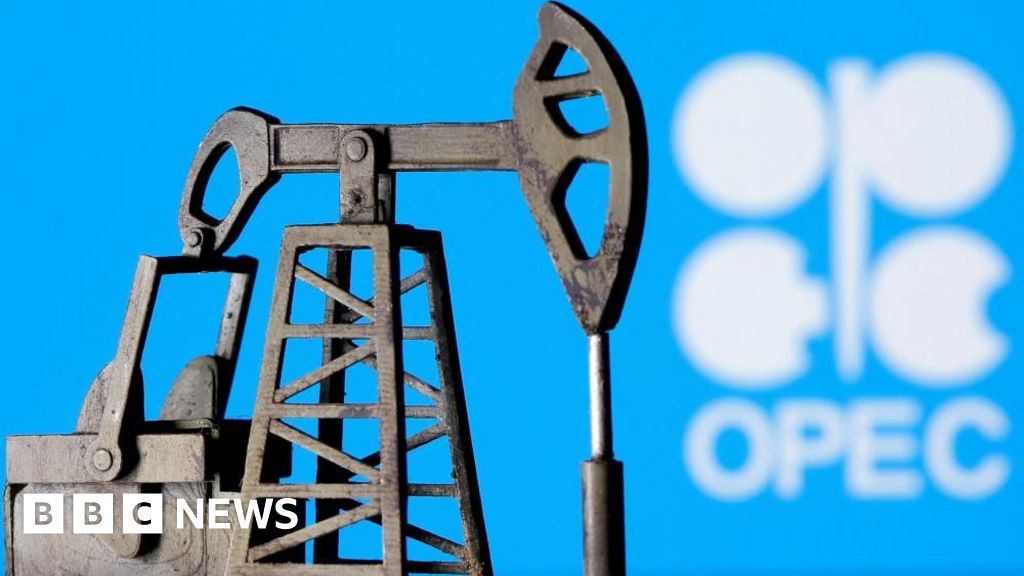
The article argues that the UAE's departure would further weaken Opec's ability to influence oil prices, with one analyst calling it "the end of Opec as we knew it." Opec produced 36.7% of global crude oil in 2025, down from 52.5% in 1973, while the UAE produced 3.1 million barrels per day and could add roughly 1 million barrels per day outside the group. The near-term market backdrop is already volatile, with the Strait of Hormuz effectively closed for eight weeks and global oil exports under pressure.
The market is likely underpricing the structural, not just symbolic, damage to OPEC's price-setting credibility. Once a major Gulf producer exits, the cartel’s constraint mechanism weakens because compliance becomes less about formal quotas and more about informal coalition management; that tends to reduce the marginal effectiveness of any future cuts unless Saudi Arabia is willing to absorb a larger share of restraint. In practice, that shifts the burden of price support onto a smaller group and increases the odds of quota slippage across the rest of OPEC+, which should cap upside in front-month crude even if headline geopolitics stay tense.
The second-order winner is not just UAE growth, but any non-OPEC supply source that can respond faster than the cartel can coordinate. US independents and Canadian producers gain relative bargaining power if benchmark volatility rises but the long-run political narrative turns against managed scarcity; meanwhile, downstream consumers and refiners may benefit from a less credible supply cartel if it lowers the risk premium embedded in deferred curves. The bigger medium-term effect is on capital allocation: if OPEC discipline is seen as deteriorating, investors may demand a higher discount rate from long-cycle upstream projects and a lower terminal price assumption for integrated majors.
The key risk to this bearish-OPEC thesis is that a loss of discipline can also trigger a short, sharp overshoot higher if Saudi Arabia chooses to defend price aggressively or if Hormuz-related supply constraints persist. That would create a term structure squeeze in the next few weeks, not necessarily a durable bull market. Over a 3-12 month horizon, however, any resolution of the transport bottleneck would expose the cartel’s diminished ability to manage the downside, making the current situation more likely to flatten the curve than to sustain a new supercycle.
Consensus may be too focused on the political headline and not enough on the incentive effects. The real question is whether this accelerates a regime where OPEC becomes a price observer rather than a price maker; if so, the move is not merely disruptive but potentially inflationary for commodity volatility while being mildly bearish for the absolute oil price over time. That asymmetry argues for owning volatility rather than outright direction until export constraints clear and compliance risk can be re-priced.
AI-powered research, real-time alerts, and portfolio analytics for institutional investors.
Request DemoOverall Sentiment
mildly negative
Sentiment Score
-0.15
