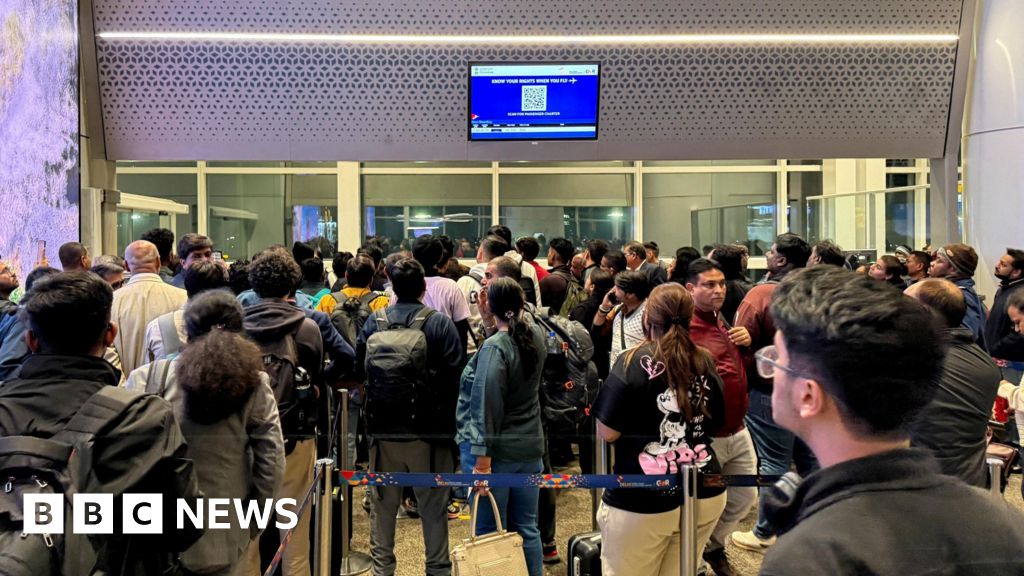
IndiGo has cancelled more than 300 flights since Tuesday — with major disruptions at Delhi, Mumbai and Bengaluru (reported: 33 cancellations at Delhi, 85 at Mumbai, 73 at Bengaluru) — blaming technical glitches, weather and new Flight Duty Time Limit (FDTL) crew rostering rules. The carrier, which holds over 60% of India’s domestic market, is facing regulatory scrutiny and reputational damage after surveys showing 54% of passengers reported timeliness issues; the Federation of Indian Pilots disputes attributing the cancellations solely to FDTL. Continued schedule adjustments to stabilise operations may pressure near-term capacity, revenues and investor sentiment while raising the prospect of regulatory action or additional operational costs.
Market structure: IndiGo (market share ~60%) faces an operational shock — >300 cancellations over a multi-day window — representing a material short-term capacity hit (order-of-magnitude: mid-single-digit % of weekly domestic seats). Direct beneficiaries are rival carriers with spare crew/slots (SpiceJet NSE: SPICEJET, Air India/Tata group routes), airport retail/MROs that capture re-booking and maintenance revenue, and travel-insurance issuers; losers are IndiGo's revenue per available seat mile (RASM), brand equity and near-term load factors.
Risk assessment: Near-term (days) risk is continued cancellations, refunds and elevated IR costs; short-term (weeks–3 months) a 1–3ppt load-factor decline could translate into a 5–15% EPS swing for IndiGo if sustained. Tail scenarios (5–15% probability) include DGCA sanctions or mandated capacity caps and >50bps sector credit-spread widening; hidden dependencies include wet-lease availability, pilot hiring lead-time (3–6 months) and contagion to OTAs and airports.
Trade implications: Favor asymmetric downside protection on InterGlobe Aviation (NSE: INDIGO) — buy 3-month put spreads to limit cost and benefit from rising IV; implement a short–long pair (short INDIGO, long SPICEJET) sized 1–3% notional with 6–12 week horizon and strict 6–8% stops. Rotate modest exposure into airport/operator beneficiaries (GMRINFRA) and MRO/service names for 6–12 months as consolidation/market-share reallocation plays out.
Contrarian angles: Consensus assumes permanent share loss; history (e.g., network carriers post-tech meltdowns) shows rapid recovery if fixes and limited sanctions — therefore plan a defined re-entry: if INDIGO falls >15% and regulator issues no material sanction within 14 days, accumulate a tactical 1–2% long using covered-call overlays. Also consider that rivals may lack spare crew capacity, so market-share transfer could be smaller than feared.
AI-powered research, real-time alerts, and portfolio analytics for institutional investors.
Request DemoOverall Sentiment
moderately negative
Sentiment Score
-0.50
