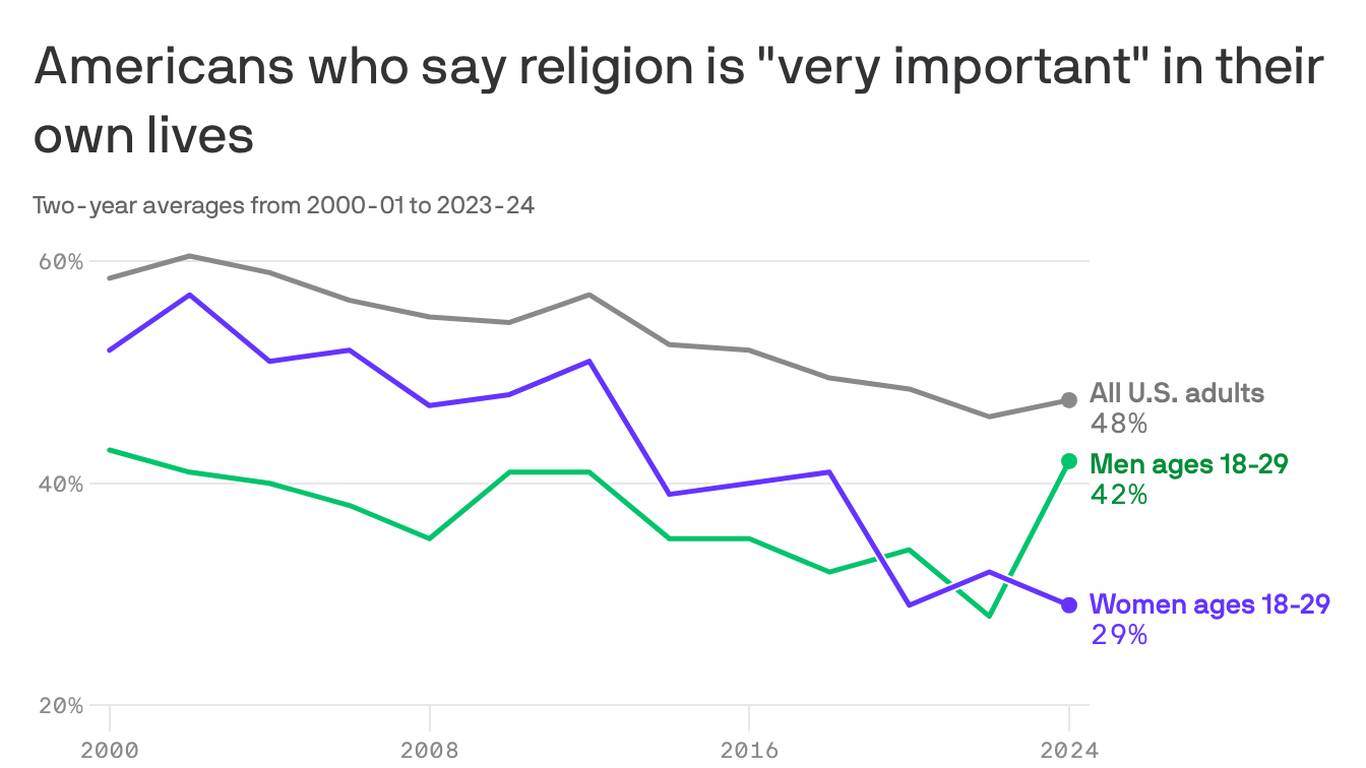
Gallup found 42% of U.S. men ages 18-29 now say religion is very important in their lives, up from 28% a few years ago, while young men’s monthly-or-more religious attendance has risen to about 40%. The article says the trend is real but limited, with no evidence of a broad national Gen Z revival and Gen Z adults still showing 34% religiously unaffiliated, 11% weekly attendance, and 38% never attending. The main implication is political and cultural rather than direct market impact.
The investable signal here is not a broad religiosity rebound; it is a segmentation shift toward a narrower, more identity-driven cohort of young men. That matters for politics and consumer behavior because small changes in high-engagement subgroups can outsizedly influence turnout, media consumption, dating norms, and household formation narratives even if national aggregates barely move.
The second-order winner is the ecosystem that monetizes community, discipline, and status signaling: faith-oriented media, event brands, and local service businesses that benefit from higher in-person participation. The loser is the secular attention economy if this cohort spends less time in late-night entertainment, gaming, and creator-driven doomscrolling; even modest weekly reallocation can pressure marginal ad inventory in youth-skewing channels over a multi-year horizon.
From a market standpoint, the more important catalyst is political, not spiritual. If this is real, it likely shows up first in campus politics, 2026 midterm turnout, and issue salience around gender roles, marriage, and education rather than in church balance sheets. The trend is also fragile: a recession, a broader male loneliness backlash, or scandal within high-profile congregations could reverse the narrative quickly, and the data is still too noisy to underwrite a national revival thesis.
Consensus is overpricing the idea of a mass revival and underpricing the durability of a niche cultural rotation. The right trade is not to bet on churches as a macro theme, but to position around the politics and media that amplify young male identity formation. If this persists for 12-24 months, it should modestly improve the engagement profile of conservative-aligned media and election-cycle messaging, while leaving secular discretionary consumption broadly intact.
AI-powered research, real-time alerts, and portfolio analytics for institutional investors.
Request DemoOverall Sentiment
mildly positive
Sentiment Score
0.15
