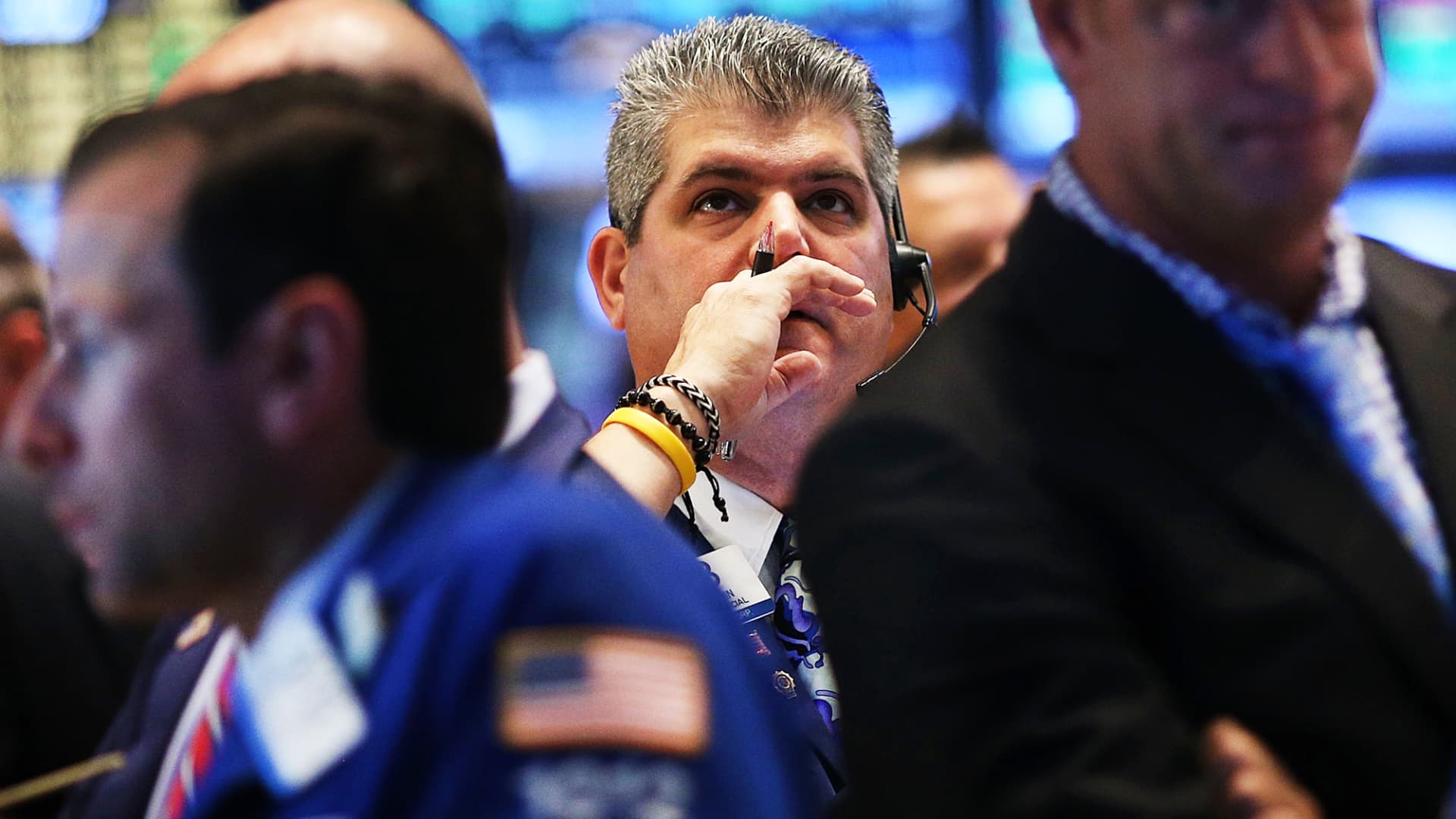
The S&P 500 rose modestly as investors weighed Middle East tensions, including Trump’s announced blockade on the Strait of Hormuz, after the market’s best weekly showing since November. On the stock-specific side, Starbucks was upgraded to hold with a higher $92 price target, while Nike was cut to hold with a sharply reduced $48 target; Jim Cramer also said the Club sold some Broadcom into the rally. Overall tone was mixed and defensive, with opportunistic trimming on strength.
The market is being asked to price two opposing regimes at once: a geopolitical risk premium that supports defensives and energy-linked cash flow, and a relief rally that is already getting crowded in the high-quality cyclical winners. In that setup, the most important second-order effect is not the headline shock itself but dispersion—stocks with stretched ownership and elevated multiples become natural funding sources when managers want to keep exposure but reduce beta. That makes recent strength in semis and consumer staples vulnerable to simple de-grossing, especially if crude volatility spills into broader risk assets. The weakest link here is not the “bad” name alone, but the catalyst path. A downgrade plus no near-term inflection creates a long-duration waiting period where every quarterly print can disappoint on cadence rather than absolute numbers, which tends to compress multiple faster than earnings estimates fall. That dynamic is harsher for apparel than for restaurants because apparel lacks the pricing/traffic visibility to reassure investors; the market usually waits for one ugly enough consensus reset before a durable bottom forms. The coffee name is more interesting: a lowered expectations bar can help only if traffic stabilizes before labor and rent inflation re-accelerate. The China simplification reduces one strategic overhang, but the real issue is U.S. unit economics and whether management can prove transaction growth without trading down mix. For a stock that often trades on narrative momentum, a slow-fix turnaround can stay investable for months while still underperforming the market. The cleanest read-through is that the club is signaling a trim-the-winners, own-the-prove-it names posture. That is sensible tactically, but the contrarian angle is that the strongest short candidate may be the one with the biggest estimate gap, not the worst headline—if consensus has already capitulated, upside from a bad-news washout can be asymmetric. Conversely, the chip winner with strong fundamentals may still be a near-term source of supply if the macro tape stays uncertain, even though the long-term thesis is intact.
AI-powered research, real-time alerts, and portfolio analytics for institutional investors.
Request DemoOverall Sentiment
neutral
Sentiment Score
-0.05
Ticker Sentiment
