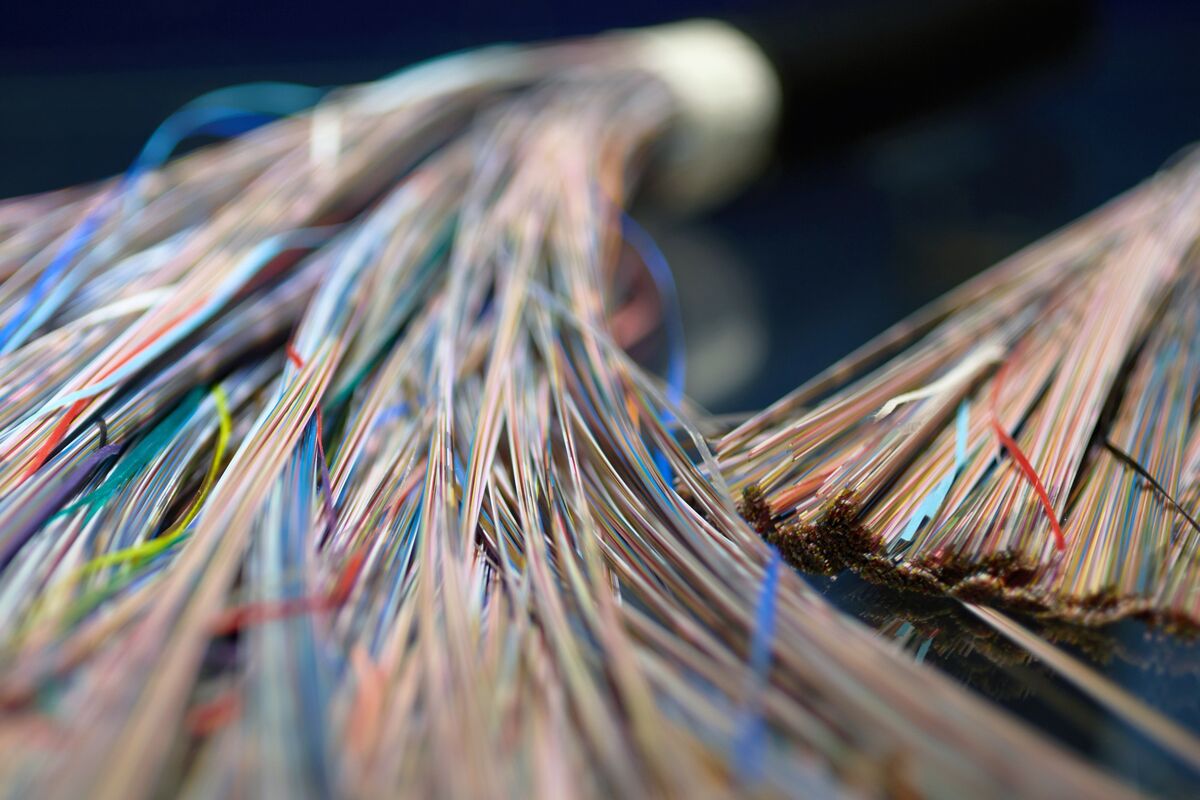
Fujikura Ltd. lost nearly half its market value in the week through May 20, a $40 billion selloff that highlights how fragile the AI-driven rally has become. The optical fiber cable maker was hit by a disappointing earnings forecast and a weak medium-term plan, and although the stock has recovered some losses, it remains almost 30% below its May 13 closing high. The move underscores sharp investor repositioning in AI infrastructure names.
The key signal is not that one cable maker missed — it is that the AI buildout trade is still being priced as a one-way demand annuity, while the real economy of the capex cycle is much more cyclical. Subcontracted infrastructure suppliers are the first place where order normalization shows up, so the selloff implies investors are starting to separate hyperscaler demand from the vendor layer that is most exposed to timing slips, mix degradation, and margin resets. That usually matters more for sentiment than fundamentals because these names often act as a high-beta proxy for the entire AI hardware stack.
Second-order pressure should hit the adjacent supply chain: optical components, connectors, passive networking gear, and regional peers with similar end-market exposure but weaker balance sheets. If customers are stretching purchase commitments or pushing out installations, the pain tends to move upstream over the next 1-2 reporting cycles, not instantly, which is why the market can overshoot before estimates fully catch down. The most vulnerable names are those trading on peak-order-book assumptions or multiple expansion rather than earnings durability.
The contrarian read is that the move may be partially a positioning unwind rather than a clean fundamental repricing. When a narrow leadership theme becomes crowded, any guidance disappointment can trigger systematic de-risking, making even modest misses look like regime shifts. That creates an opportunity to fade the weakest balance sheets or the most levered beta, while remaining selective on the true platform beneficiaries whose capex is funded by cash generation rather than speculative growth assumptions.
Catalyst-wise, the next 30-90 days matter most: follow-on guidance from suppliers, backlog conversion rates, and whether peers confirm similar moderation in order cadence. If large AI buyers maintain spending but shift mix toward lower-cost interconnect solutions, the earnings pool may rotate rather than shrink, which would punish the most expensive hardware-adjacent names and favor the cheapest picks-and-shovels. The risk to the bearish thesis is a renewed hyperscaler capex update that restores confidence fast; the risk to the bullish contrarian is that this is the first sign of a broader digestion phase in AI infrastructure spending rather than a single-company issue.
AI-powered research, real-time alerts, and portfolio analytics for institutional investors.
Request DemoOverall Sentiment
strongly negative
Sentiment Score
-0.55
