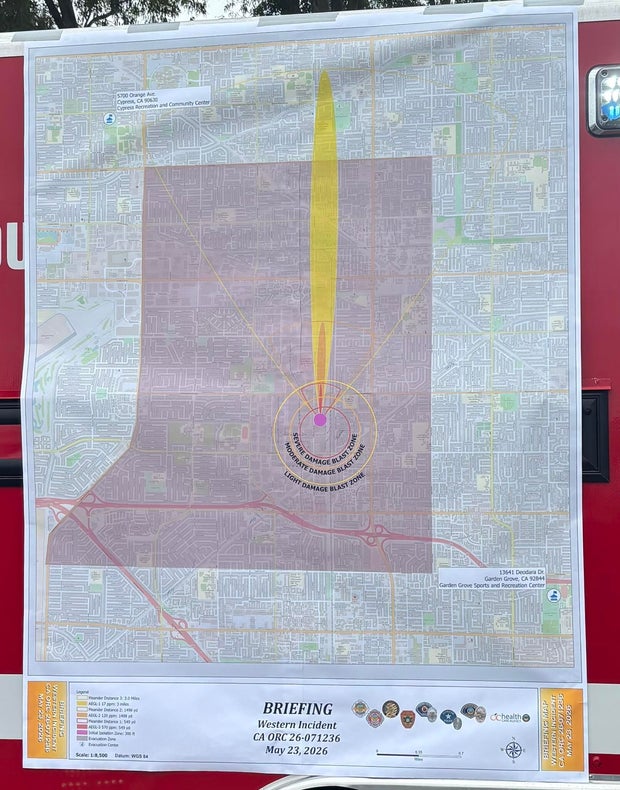
California declared a state of emergency in Orange County after a toxic chemical tank at GKN Aerospace in Garden Grove continued heating, prompting evacuations of more than 50,000 residents. The tank is estimated to contain about 7,000 gallons of methyl methacrylate, with officials warning of possible spill or explosion risks and no clear timetable for resolution. The incident has triggered a public investigation and widespread school and community disruptions, though nearby major venues said they remain unaffected.
This is less a single-asset event than a localized industrial shock with broader read-through to hazmat liability, municipal disruption, and aerospace supply-chain fragility. The market should treat it as a tail-risk catalyst for contractors with combustible/chemical handling exposure: even if direct operational damage is contained, the post-event bill can migrate into remediation, litigation, insurance deductible resets, and contract scrutiny. The first-order move is reputational; the second-order move is margin pressure from higher compliance and tougher terms on environmental coverage across the sector.
For aerospace suppliers, the key issue is not the headline site itself but the precedent: customers will pressure smaller manufacturing nodes for redundancy, safety capex, and continuity plans. That favors larger primes and vertically integrated suppliers with diversified footprints, while disadvantaging single-site specialty processors and any name already carrying elevated environmental reserve risk. If the incident escalates or drags on for weeks, expect a short-term premium on industrial insurers and E&S carriers, but also the possibility of a later claims overhang if investigators find maintenance or process-control failures.
The contrarian angle is that the immediate equity reaction may be too narrowly focused on the evacuation radius and not enough on the probability of a prolonged legal/regulatory cycle. These incidents often look binary intraday but become multi-quarter earnings drags through remediation, legal fees, and permit friction. The safest read is that this is a negative sentiment shock for the broader defense/industrial complex, but the highest-conviction trade is on the risk transfer layer, where pricing can re-rate faster than operating companies.
Over a 1-4 week horizon, the market should keep a close eye on whether officials can credibly stabilize the tank without a catastrophic release; a clean resolution would likely compress the event premium quickly, while any explosion/secondary contamination would extend the trade into months. The bigger reversal trigger is not just physical containment, but clarity that liability sits with the operator rather than a broader ecosystem of contractors and insurers.
AI-powered research, real-time alerts, and portfolio analytics for institutional investors.
Request DemoOverall Sentiment
strongly negative
Sentiment Score
-0.72
Ticker Sentiment
