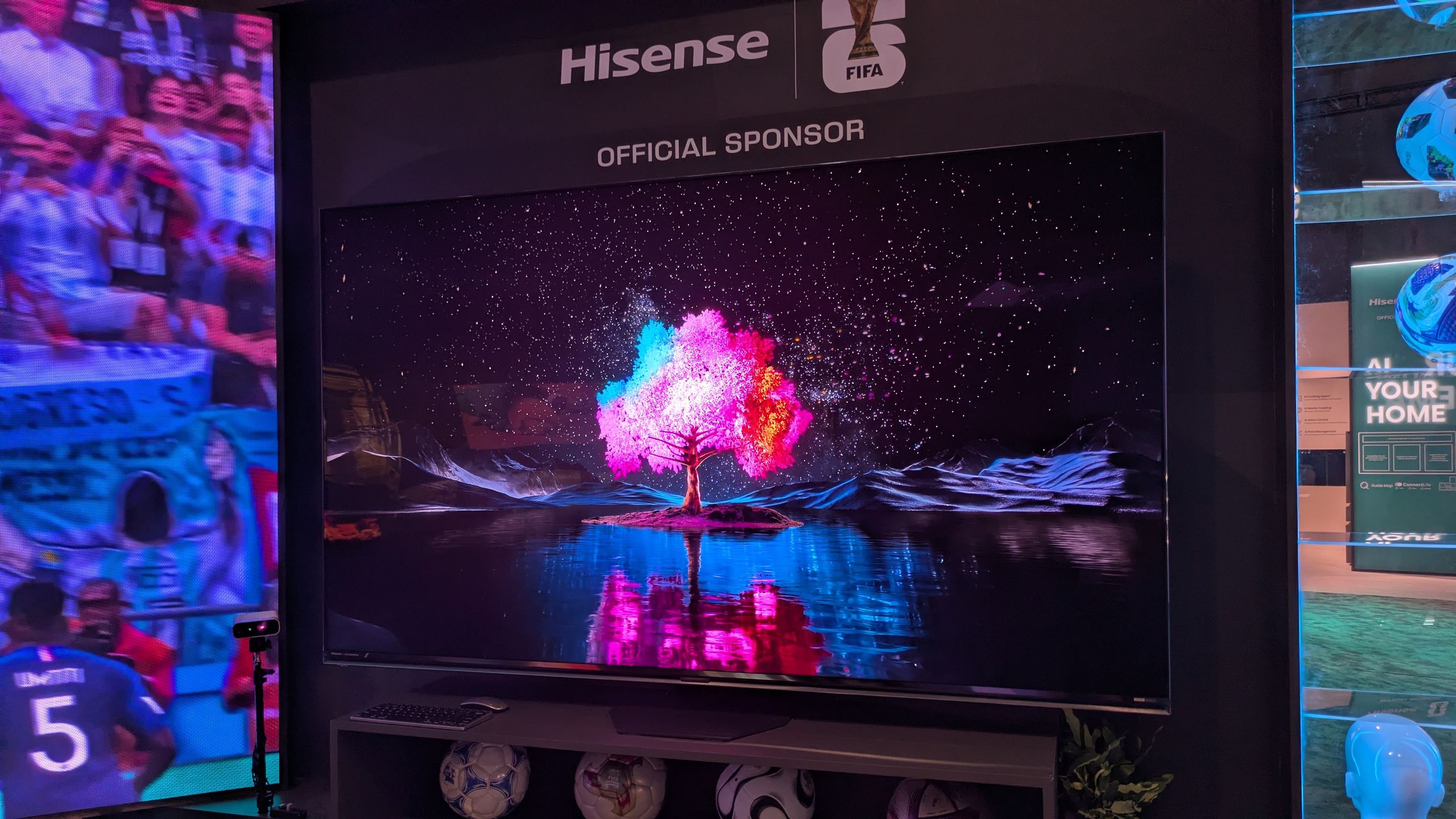
Manufacturers including Hisense, LG and Samsung are rolling out RGB mini-LED (Micro RGB) TVs in 2026, aiming to challenge OLED by combining much higher peak brightness with richer color; a Hisense 116-inch UX measured 6,014 nits peak HDR (Vivid) and >1,000 nits fullscreen, versus flagship OLEDs measured at 2,268 nits (LG G5) and 2,135 nits (Samsung S95F) peak HDR and only ~390 nits fullscreen. RGB mini-LED adoption across sizes from 55 inches and tentative pricing plans could pressure OLED market share if manufacturers solve persistent local-dimming/clouding and black-level uniformity issues; if costs fall toward current OLED pricing (~$2,499 for a 55-inch LG G5), the technology could materially alter competitive dynamics in the TV market.
Market structure: RGB mini‑LED shifts the competitive map toward OEMs and component suppliers that can scale RGB LED arrays and advanced drivers — winners include Samsung Electronics (005930.KS) and TCL (01070.HK) as adopters, plus LED chip/driver suppliers; pure OLED panel specialists face margin pressure if RGB approaches OLED blacks. Pricing power will be contested: initial RGB sets will likely command a 10–30% premium to standard mini‑LED but could undercut OLED within 12–24 months if yields rise and 55" SKUs price within 10% of flagship OLEDs.
Risk assessment: tail risks include production yield failures (LED binning issues) that could double component costs for 3–6 months, patent litigation between major OEMs, or a sudden OLED brightness/price innovation that preserves OLED share. Time horizons: media hype (days-weeks), product launches and reviews (0–3 months), mass adoption and meaningful share shifts (12–36 months). Key hidden dependency is LED supply concentration — a single supplier outage could spike component costs 20–40%.
Trade implications: tactical longs in suppliers/OEMs that publicly commit to Micro RGB ahead of broad releases, with event-driven sizing around CES/first reviews; use call-spreads to limit carry. Pair trades: long TCL (01070.HK) / short LG Electronics (066570.KS) if early pricing shows RGB undercutting OLED in 55" MSRP; profit if market share rotates. Rotate portfolio overweight to consumer electronics and LED semiconductor suppliers, underweight pure OLED panel plays over the next 12–24 months.
Contrarian angle: the market may overestimate RGB’s ability to fully replace OLED — physics (local dimming granularity) still favors true self‑emissive pixels for uniform blacks, so adoption could be confined to high‑brightness niches rather than mainstream replacement. If RGB prices stay >20% above standard mini‑LED for >12 months due to yield limits, OEMs may delay conversions and investor enthusiasm will be premature. Historical parallel: early QLED/mini‑LED hype led to cyclic pricing and consolidation; expect similar shakeouts and choose suppliers with diversified end‑markets.
AI-powered research, real-time alerts, and portfolio analytics for institutional investors.
Request DemoOverall Sentiment
mildly positive
Sentiment Score
0.25
Ticker Sentiment
