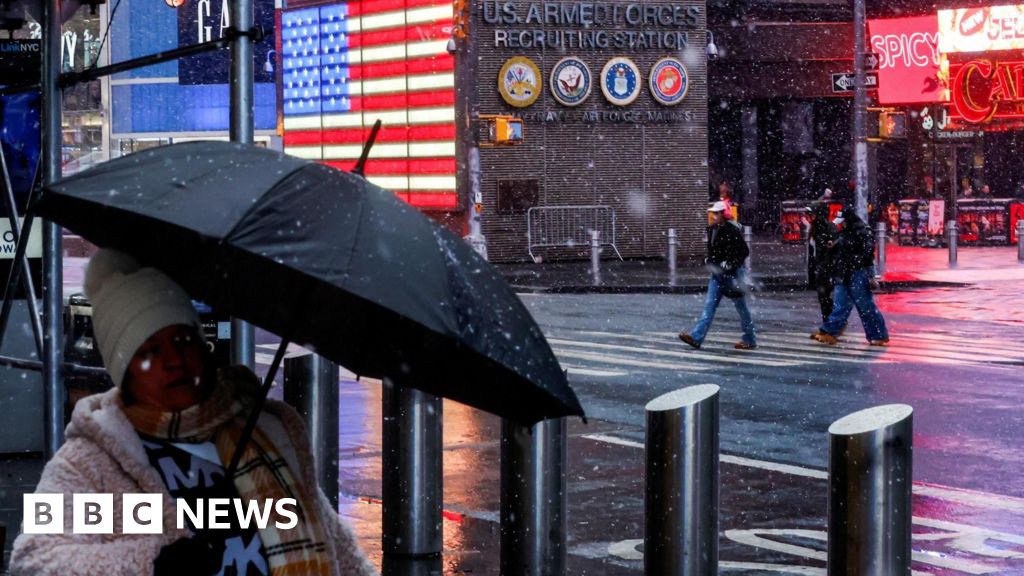
A historic nor'easter is impacting the US northeast and Canadian Maritimes with roughly 54 million people under blizzard or winter-storm warnings, prompting state-of-emergency declarations, a New York City travel ban (2100 EST Sunday to 1200 EST Monday) and activation of about 100 National Guard members. Forecasts call for 18–24 inches of snow in the NYC metro (locally up to 28 inches), 65–70 mph coastal gusts, more than 3,500 U.S. flight cancellations and widespread transit and commercial-vehicle bans — signaling acute short-term disruption to transportation, regional supply chains, energy distribution and retail activity.
Market structure: Near-term winners are home-improvement retailers (HD, LOW), emergency services/contractors (PWR, EMR), and short-dated natural gas/power exposures as heating demand spikes; losers include airlines (AAL, UAL), regional transit operators, and property insurers with coastal portfolios. Pricing power shifts transiently to local labor/contractors and fuel suppliers; freight capacity tightness can push spot trucking/rail rates +5-15% for 1–4 weeks in the Northeast corridor. Cross-asset: expect short-lived US Treasury safe-haven demand (2–8 bps lower yields intraday), a 5–20% vol pop in carrier and energy options, and a 2–8% positive shock to prompt Henry Hub/power forwards for 7–14 days.
Risk assessment: Tail scenarios include prolonged outages/catastrophic coastal flood losses (> $1bn insured losses) that would materially hit insurers/reinsurers and municipal finances; regulatory scrutiny around infrastructure response could follow. Immediate horizon (0–7 days) is operational disruption and revenue/earnings noise; 1–3 months sees repair-driven demand and possible rate pass-throughs; beyond a year effects are marginal absent repeat storms. Hidden dependencies: port/rail knock-on delays could reroute freight inland, amplifying regional congestion and inventory shortages; contagion to retail sales is possible if urban centers remain shut >72 hours. Key catalysts: post-storm insured-loss estimates, National Guard/deployment updates, and Nymex gas/power forward prints.
Trade implications: Favor short-dated, convex trades: buy 2–6 week NG call spreads (NYMEX prompt month) and airline 2–4 week puts (AAL/UAL) to capture volatility spike and downside from cancellations. Establish small equity tilts: 1–3% longs in HD/LOW and PWR for repair demand, paired with 1% shorts in regional carriers/JBHT to express transport disruption. Use options to control downside (defined-loss call spreads for gas; buy puts for carriers); size conservatively (total weather risk bucket 3–5% notional).
Contrarian angles: Consensus may over-penalize large-cap diversified insurers and legacy carriers for a single storm; if insured losses remain < $1bn market will revert within 7–14 days creating mean-reversion trades. Historical parallels (2013–2015 nor’easters) show retail and contractor stocks rebound +5–12% within a month post-restoration while carriers underperform only if balance sheets weaken materially. Unintended consequence: aggressive travel bans and quick reopening can create a strong retail rebound — look for opportunities to buy the dip in high-quality retailers within 10 trading days post-storm clearance.
AI-powered research, real-time alerts, and portfolio analytics for institutional investors.
Request DemoOverall Sentiment
moderately negative
Sentiment Score
-0.35
